
- Why The First 90 Days Matter When Opening a New Location
- Common Marketing Mistakes Businesses Make When Opening a New Location
- Days 1-30: Build the Foundation Before Launch
- Days 31-60: Launch Campaigns and Create Visibility
- Days 61-90: Optimize, Expand, and Turn Launch Activity into Long-Term Growth
- Case Study: New Location Marketing for Mountain View Orthodontics
- What Every New Location Marketing Plan Should Include
- Your New Location Needs More Than a Launch Announcement
- Work With Renaissance Marketing to Launch Your Next Location Strategically
Opening a new location is exciting. It usually means that your business is growing, the brand is gaining momentum, and there is a new market ready to be served.
But opening a new location does not automatically mean that new revenue will follow.
A new office, storefront, practice, or service area needs more than a ribbon-cutting ceremony and a “Now Open” announcement. It needs a strategic new location marketing plan that builds visibility before launch, creates demand during launch, and turns early attention into long-term growth after the doors open.
For many businesses, the first 90 days matter more than they realize. This is the window when your new market starts forming an opinion about your brand. It’s when Google starts connecting your business to the new location, and it’s when early customers, patients, or clients begin deciding whether you are the right choice.
A strong 90-day new location marketing plan can help your new location get found, get trusted, and get chosen.
Why The First 90 Days Matter When Opening a New Location
Opening a new location is not just an operational milestone. It is a market entry strategy.
Even if your business is well-known in another city, region, or service area, a new location often starts with limited local awareness. People in the new market may not know who you are, what you offer, or why they should choose you over an established local competitor.
That is why the first 90 days are so important! During this period, your business needs to introduce itself clearly, build trust quickly, and create multiple ways for people to discover and engage with your new location.
You Are Entering a Market Where People May Not Know You Yet
A business with strong brand recognition in one city may still be unfamiliar in another. Your new location needs to establish its own local presence. That means your marketing should answer a few key questions:
- Who are you?
- Where are you located?
- What services do you provide?
- Who do you serve?
- What makes your business different?
- How can someone take the next step?
Without a clear launch strategy, a new location can open quietly and rely too heavily on word of mouth, existing brand equity, or the hope that people will find it naturally.
Search Visibility Takes Time to Build
Local SEO doesn’t happen overnight. Google needs time to understand your new location, connect it to your website, associate it with the right services, and recognize its relevance in the market. Your location page, Google Business Profile, citations, reviews, service content, and local authority signals all play a role.
The earlier these pieces are created and optimized, the better positioned your business is to compete in search results. You should ideally start a new location SEO plan three to six months before opening. Waiting until after the doors open can delay visibility at the exact moment when you need momentum most.
Paid Media Can Create Early Momentum While SEO Builds
SEO is critical for long-term growth, but a new location also needs immediate visibility.
That’s where PPC, paid social, programmatic advertising, and retargeting can help. Paid media gives your business a way to reach people in the new market quickly while organic search visibility continues to develop.
Google Search campaigns can capture people already looking for your service, paid social can introduce your new location to targeted audiences, and retargeting can keep your brand visible after someone visits your website but does not convert right away.
A strong launch plan should use both short-term and long-term marketing channels together. At Renaissance, we recommend launching a brand campaign announcing your new location before opening day.
Launch Momentum Fades Without a Plan
A grand opening can create attention, but attention fades fast. The first 90 days should not be treated as one campaign or one announcement. Your launch should include a sequence of activities that build awareness, generate engagement, capture demand, and improve performance over time.
The goal is not just to make noise when the location opens. The goal is to create a foundation for sustainable growth in that market, which is why ongoing marketing is so important after launching.
Common Marketing Mistakes Businesses Make When Opening a New Location
Many businesses put a lot of energy into the physical opening of a new location but wait too long to plan the marketing behind it. That delay can make it harder to generate early leads, rank locally, earn reviews, and compete with businesses that are already established in the area. Here are some of the most common mistakes that you should avoid.
Waiting Until the Location Opens to Start Marketing
Marketing should begin before the new location officially opens. Your website, Google Business Profile, paid campaigns, social content, email announcements, PR materials, and local visibility strategy must be prepared ahead of the launch. This gives your business time to build anticipation and make sure the right digital assets are ready when people start searching. If marketing begins after opening day, your business may spend the first several weeks playing catch-up.
Copying and Pasting the Strategy From Another Location
What worked in one location may not work the same in another. Each market has its own search behavior, competition, audience, and conversion opportunities. A new location strategy should be customized based on the market — not just copied from an existing location. A strong new location marketing plan should include market research, competitor analysis, keyword mapping, budget planning, and location-specific messaging.
Launching Without a Dedicated Location Page
Every new location should have its own dedicated page on the website. This helps both users and search engines understand where the new business is located, what services are offered, and how someone can take the next step. It also gives your paid campaigns, Google Business Profile, local listings, and internal website structure a clear destination.
Forgetting About Google Business Profile
For local businesses, a Google Business Profile is one of the most important launch assets. A new or updated Google Business Profile can help your new location appear in local search and Google Maps. It also gives potential customers a very quick way to call, visit the website, get directions, read reviews, view photos, and understand what your business offers. If you need assistance with setting up a new Google Business Profile and making sure it is fully optimized for your new location, the Renaissance Marketing team can help you.
Treating the First 90 Days Like a Branding Campaign Only
Though brand awareness matters, a new location still needs measurable action. Your launch marketing should support business goals like calls, form submissions, bookings, consultations, appointments, visits, and qualified leads. This means your strategy needs clear conversion paths, campaign tracking, and reporting from the very start. A beautiful launch campaign is not enough if it does not help the new location grow.
Your 90-day Marketing Plan for Opening a New Location
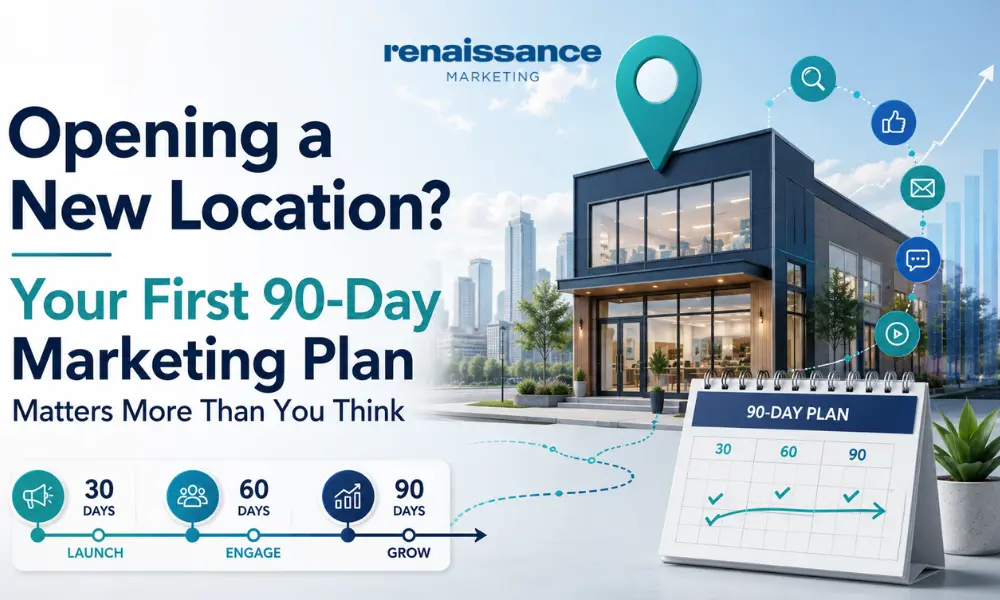
A strong new location marketing plan should be phased. The first 30 days should focus on the foundation. The next 30 days should focus on visibility and campaign launch, and the final 30 days should focus on optimization, reporting, and growth. Here is how to structure your 90-day New Location marketing plan.
Days 1-30: Build the Foundation Before Launch
The first phase is about preparation. Before you spend any money driving traffic to the new location, make sure your digital foundation is ready to support that traffic. Otherwise, you could be wasting ad spend and not getting any measurable results.
Define the Market and Audience
You should start by identifying the exact market you are trying to reach. This includes your primary service area, surrounding cities or neighborhoods, target audience, local competitors, high-value services, and market-specific opportunities. For example, a healthcare practice opening in a lake community may need different messaging than a practice opening in a dense urban market. A home services company expanding into a suburban region may need different keyword targeting than it uses in its home city. The more specific you are with who your market and audience is, the stronger your launch strategy will be.
Create Your New Location Landing Page
Your location page should be built before your launch, not after. This page should clearly explain who your new location serves, what services are available, where it’s located, and how someone can schedule, call, or request more information. A strong new location page should include:
- A location-specific headline
- A clear service overview
- Address, phone number, and hours, when applicable
- Map or service-area information
- Strong calls to action
- Photos of the location, team, or surrounding area
- FAQs specific to the market
- Internal links to related service pages
- LocalBusiness or location schema markup
This page becomes a central piece to your launch strategy. It will support your SEO, PPC, Google Business Profile, social campaigns, email marketing, and retargeting efforts.
Set Up or Optimize a Google Business Profile
Your Google Business Profile should be completed as early as possible. It’s important to make sure the business name, address, phone number, website link, categories, services, description, and hours are all accurate. You should also add photos, details regarding your launch, and appointment links where appropriate. If the location is not open yet, you can still prepare assets, plan your profile strategy, and make sure everything is ready to go live at the right time. For businesses with multiple locations, it is also important to keep naming conventions, service categories, and website links consistent across profiles.
Prepare Tracking and Reporting
Before campaigns launch, tracking needs to be in place. Your team should be able to measure where leads are coming from, which channels are working, and how the new location is performing.
To do this, your tracking setup should include:
- Google Analytics to see how much traffic is coming to your site and which channels are performing the best
- Google Tag Manager to set up key events so you can know which actions customers are taking, i.e., phone calls, form submissions, booked appointments
- Google Search Console to see which pages and queries are being searched and viewed the most
- Call tracking to see if phone calls are valid leads and what the customer service/call quality is like
- Form tracking to review lead validation and ensure fast response times
- Google Ads conversion tracking to make sure your ad dollars are turning into measurable action
- CRM to manage conversations with your leads, all in one place
- Market-specific reporting to understand which locations are performing well and which locations need more assistance
Without proper tracking, it becomes difficult to know whether your launch plan is actually generating qualified opportunities.
Build the Launch Messaging
The messaging for your launch should be clear and consistent across every channel. It should explain why the location is opening, who it serves, what services are available, and what makes the business different. It should also give people a clear next step on what action they should take, whether that be scheduling an appointment, calling the office, requesting a quote, or visiting the website. This messaging should be used across all marketing efforts: landing pages, ads, social posts, email campaigns, press materials, and GBP updates.
Days 31-60: Launch Campaigns and Create Visibility
Once the foundation is in place, the next phase is about making the right people aware of your new location. This is where SEO, PPC, paid social, PR, local content, and community marketing should start working together.
Run PPC Campaigns for Immediate Demand
Google Search campaigns can help capture people who are already looking for your service. For a new location, PPC campaigns may include:
- Brand plus location searches
- Service plus city keywords
- High-intent “near me” searches
- Appointment, consultation, or quote-based keywords
- Competitor-adjacent searches, when appropriate
Paid search can be especially useful during the early launch period because it gives your business visibility while organic rankings are still building. Renaissance specializes in new location pay-per-click campaigns. See how we helped Hodges Dental Care create immediate visibility for their new location through Google Search Ads.
Use Paid Social to Build Local Awareness
Paid social can be used to introduce your new location to people who may not be actively searching yet. This is especially valuable for businesses that need to build brand awareness, educate the market, or generate demand before someone is ready to convert. Paid social campaign angles may include:
- Now open in the new market
- Meet the team
- Behind-the-scenes location content
- New patient, client, or customer offers
- Community involvement
- Service education
- Testimonials or proof points from other locations
The goal is to make the new location feel familiar before someone needs your service. We helped Mountain View Orthodontics to build brand awareness around their new Smith Mountain Lake office location with Meta ads.
Publish Local Content that Supports Search and AI Visibility
Content should absolutely be part of your new location launch campaign, as it helps search engines and AI answer platforms to understand your relevance in a specific market. For a new location, you should create content that connects services, geography, and customer intent.
Examples include:
“Now Serving [City]: [Service] for Local Customers”
“How to Choose a [Service Provider] in [City]”
“What [City] Customers Should Know Before Booking [Service]”
“Why We Opened Our New Location in [City]”
“[Service] Near [Neighborhood or Region]: What to Expect”
This type of content can support local SEO, internal linking, AI search visibility, and customer education. Showing up in multiple spots, such as Google Search Results and LLMs, will be very important for your new location’s search visibility.
Build Local Authority Signals
A new location needs more than just a page on your website. It needs signals that show the business is part of the new area. This includes adding the new location to local directories, chamber listings, sponsorships, community partnerships, local press, event listings, industry directories, and relevant backlinks. These signals help build credibility with both people and search engines.
Start Review Generation Early
Reviews are essential for a new location. It’s the first thing that most people review before deciding to move forward with a service provider or visiting a new business. Even if the overall brand has strong reviews elsewhere, the new location needs its own trust signals. A review strategy should be built into the launch plan from the beginning. It’s important that you train your team to ask happy customers, patients, or clients for reviews. You should also create an automatic system that uses direct review links via text or email. It’s just as important to respond to all reviews. Once you have a few reviews, you should also incorporate these new trust signals into your website content and future campaigns. Early reviews can make a major difference in how quickly a new location builds trust.
Days 61-90: Optimize, Expand, and Turn Launch Activity into Long-Term Growth
The final phase of the first 90 days is about learning and improving. By this point, your business should have early data from website traffic, paid campaigns, Google Business Profile activity, calls, form submissions, social engagement, and lead quality. Now it’s time to use that data and optimize your new location marketing.
Review Early Performance by Channel
Begin by looking at how each channel is contributing to your new location’s growth. Important metrics that you should review include:
- Organic traffic to the new location page
- Keyword rankings by market
- Google Business Profile calls, clicks, and direction requests
- Paid search leads
- Paid social engagement and conversions
- Cost per lead
- Conversion rate
- Lead quality
- Appointment or sales outcomes
The goal is not just to measure activity, it’s to understand what is actually moving the business forward.
Improve the Location Page Based on Real Behavior
Early website data can show you where users are engaging and where they may be dropping off. By checking Google Analytics and Google Search Console, you can use this information to improve your location page. You may need stronger calls to action, clearer service descriptions, better form placement, more visible phone numbers, additional FAQs, stronger trust signals, or more localized content. A location page should not be treated as a one-time project. It should be improved over time as you learn more about the market.
Reallocate Budget Based on What is Working
The first 90 days should help reveal where the strongest opportunities are. If one service is generating better leads, it may deserve more budget. If one audience is engaging at a higher rate, it may be worth expanding. If one campaign is producing low-quality leads, it may need to be adjusted or paused. Marketing budgets should shift based on performance, not assumptions.
Create Ongoing Market-Specific Content
After launch, continue supporting the new location with content that builds authority in the market. This may include additional blog posts, service-area pages, local FAQs, Google Business Profile posts, social content, customer stories, case studies, and community updates. Posting new content consistently will help your new location to stay visible after the initial launch period.
Build Retargeting Audiences
Not everyone who visits your website or clicks an ad will convert right away. Retargeting campaigns allow your business to stay visible to people who have already shown interest. These audiences may include website visitors, location page visitors, social engagers, video viewers, or users who clicked an ad but did not complete a form. For a new location, retargeting can help turn early awareness into future action.
Case Study: New Location Marketing for Mountain View Orthodontics
When Mountain View Orthodontics & Dental Sleep Center prepared to open its new Smith Mountain Lake location, the practice needed more than a basic “now open” announcement. They needed a launch strategy that introduced the brand to a new community, built local trust, and supported patient acquisition from the start.
Renaissance Marketing helped support the launch with clear location messaging, local positioning, press kit support, paid social media, SEO, PPC, and digital visibility recommendations.
The takeaway: opening a new location is not just a business update. It’s a market entry opportunity that requires strategy before, during, and after the launch.
Read the full Mountain View Orthodontics new location case study.
What Every New Location Marketing Plan Should Include
Every new location is different, but the core marketing foundation is often similar. A strong plan should include:
- Market research
- Competitor research
- Location landing page
- Google Business Profile setup
- Local SEO
- Citation building
- Launch messaging
- PPC campaigns
- Paid social campaigns
- Retargeting
- Review generation
- Local PR
- Community partnerships
- Email marketing
- Social media content
- Conversion tracking
- Monthly reporting
These pieces should not operate separately or in silos. They should all work together as part of one connected strategy: the location page should support SEO and paid campaigns, the Google Business Profile should connect to the website and review strategy, paid media should drive targeted traffic to optimized conversion points, while content should build authority in the market. That is how a launch becomes a growth plan.
Your New Location Needs More Than a Launch Announcement
Opening a new location takes planning, investment, and coordination. Your marketing should receive the same level of attention. A single announcement is not enough to build search visibility, generate qualified leads, earn local trust, or compete with established businesses in the market. The first 90 days should be treated as a strategic growth window.
With the right plan, your business can enter a new market with stronger visibility, clearer messaging, and a better path for long-term success. Whether you are opening one new location, expanding into a new city, or building a multi-location growth strategy, your marketing needs to connect the full picture: SEO, PPC, paid social, local visibility, website strategy, content, AI search readiness, and reporting.
Work With Renaissance Marketing to Launch Your Next Location Strategically
Renaissance Marketing helps growing businesses build strategic marketing plans for new locations, regional expansion, and multi-location growth.
Our team connects SEO, local search, PPC, paid social, programmatic advertising, content, website strategy, AI search visibility, and performance reporting into one cohesive growth plan. Opening a new location should not feel like a guessing game. It should feel like a market entry strategy.
Opening a new location? Renaissance Marketing can build a 90-day marketing plan that helps your new market find you, trust you, and choose you. Schedule a strategy call today.