
- What is Regional Marketing?
- Why Regional Marketing Matters for Growing Businesses
- Regional Marketing vs. Local Marketing vs. Multi-Location Marketing
- Start with Market Selection
- Build Market-Specific Messaging
- Create a Location Page Strategy
- Align Service Pages and Location Pages
- Use Google Business Profiles Strategically
- Run Paid Media by Market, Not Just by Channel
- Build Trust Before Expecting Conversions
- Create Content for Regional Authority
- Track Performance by Market
- Make Sure Your Website Can Convert Regional Traffic
- Common Regional Marketing Mistakes
- How Renaissance Marketing Helps Businesses Grow Regionally
- Regional Growth Requires a Market-by-Market Strategy
Growing beyond one local market is an exciting milestone for any business. It means your brand has momentum, your services are in demand, and there is an opportunity to reach more customers in nearby cities, regions, or states.
But regional growth requires more than duplicating what worked in your original market. A business that is well known in one city may be completely unfamiliar just one county over. Search behavior can change by market. Competitors may be different in every location. Customer trust has to be built locally, even when the business itself is growing regionally.
A strong regional marketing strategy helps growing businesses expand visibility, build trust, and generate leads across multiple markets without losing the local relevance that made them successful in the first place.
What is Regional Marketing?
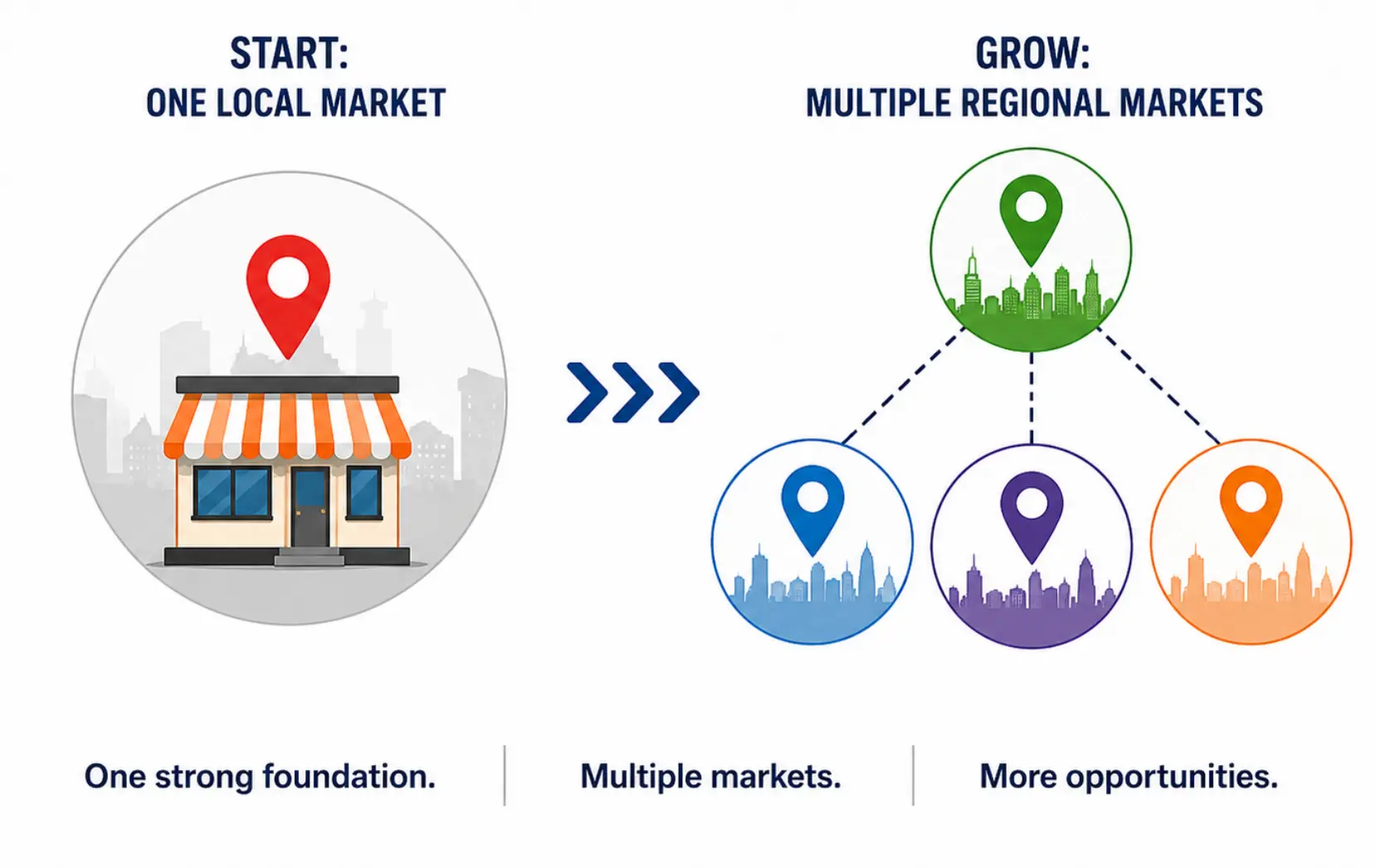
Regional marketing is a strategy designed to help a business grow beyond one local market while still staying relevant to each city, town, or service area it aims to reach. Instead of marketing to one broad audience, regional marketing considers how people search, compare, and make decisions in each target market. For example, a business expanding from Richmond into Charlottesville, Virginia Beach, or Northern Virginia may need different location pages, different local SEO priorities, different ad targeting, and different content angles for each market.
The goal is not just to say, “We serve this area.” The goal is to create a strong, trustworthy presence in each market so customers see the business as a relevant option near them.
Why Regional Marketing Matters for Growing Businesses
Many growing businesses hit a point where referrals and reputation are strong in their original market, but growth slows when they try to expand into nearby areas. That usually happens because brand awareness does not automatically transfer from one market to another.
A company may be well known in its home city, but in a new market, customers are still asking: Who are they? Do they serve my area? Are they local enough to understand my needs? Can I trust them? Are they better than the companies already established here?
Regional marketing helps answer those questions through search visibility, paid media, local content, review strategy, Google Business Profile optimization, landing pages, and consistent brand messaging.
Without a regional strategy, businesses often rely on one general website, one broad ad campaign, or one location page to do the work of an entire market expansion. That approach usually limits visibility and makes it harder to compete with businesses that already have a stronger local presence.
Regional Marketing vs. Local Marketing vs. Multi-Location Marketing
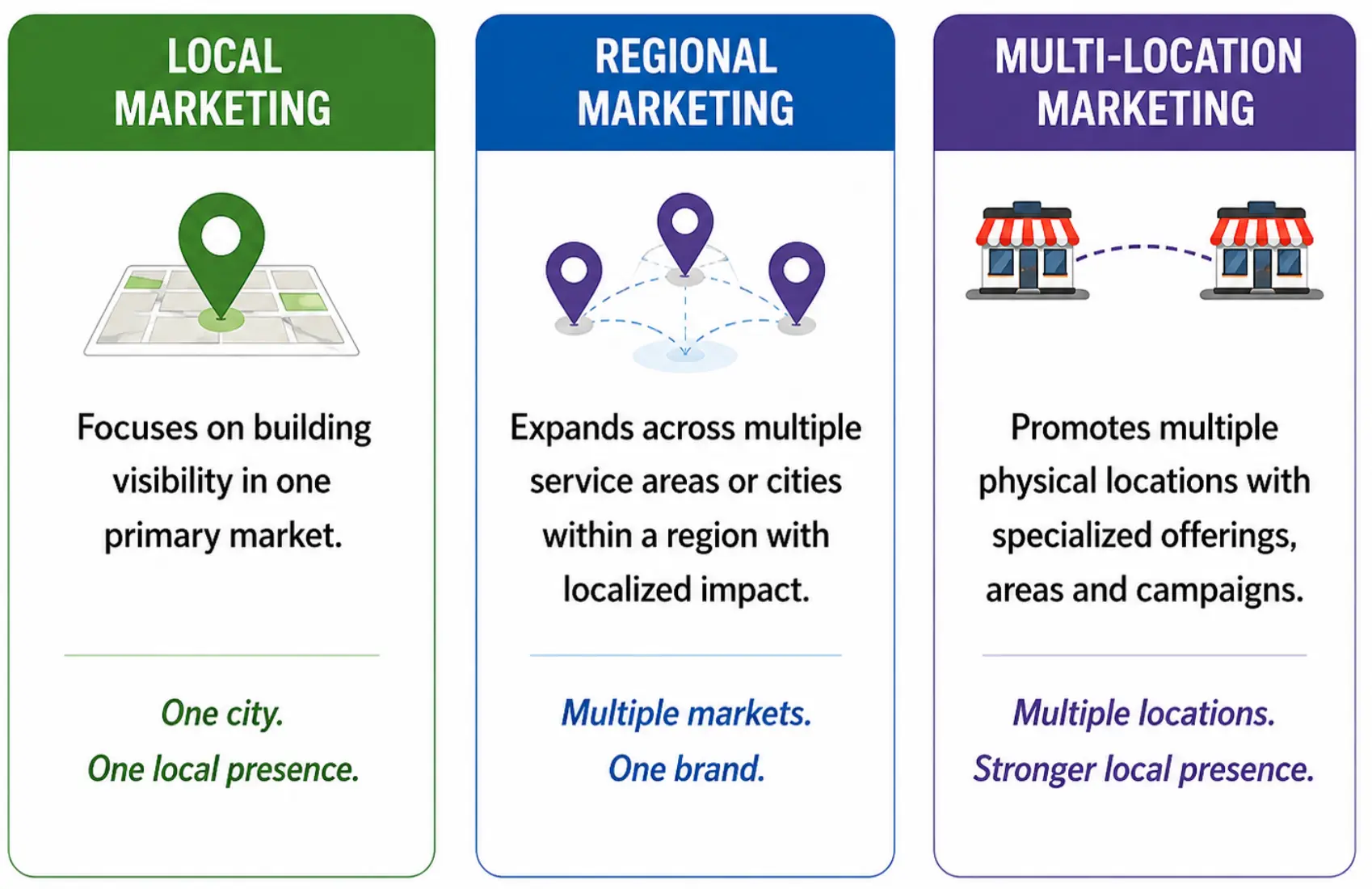
Local marketing focuses on building visibility in one primary market. Multi-location marketing focuses on promoting multiple physical locations, often with separate Google Business Profiles, location pages, and localized campaigns.
Regional marketing sits between the two. It is ideal for businesses that want to grow across multiple service areas, cities, or nearby markets, whether or not they have a physical office in every location.
Regional marketing is especially important for:
- Home service businesses expanding into nearby cities
- Dental, orthodontic, or healthcare practices opening a new location
- Moving and storage companies serving multiple regions
- Auto salvage yards with multiple locations or service areas
- Professional service companies targeting more than one metro area
- Franchise, dealer, or regional service brands
- Businesses opening a second location
- Companies trying to rank and generate leads in more than one city
The strategy must connect the dots between local search, brand awareness, paid media, and market-specific trust.
Start with Market Selection
Before investing in regional marketing, businesses need to decide which markets are actually worth pursuing. Not every nearby city deserves the same level of budget, content, or campaign effort. A strong regional marketing strategy starts by evaluating each potential market based on opportunity.
Important questions include:
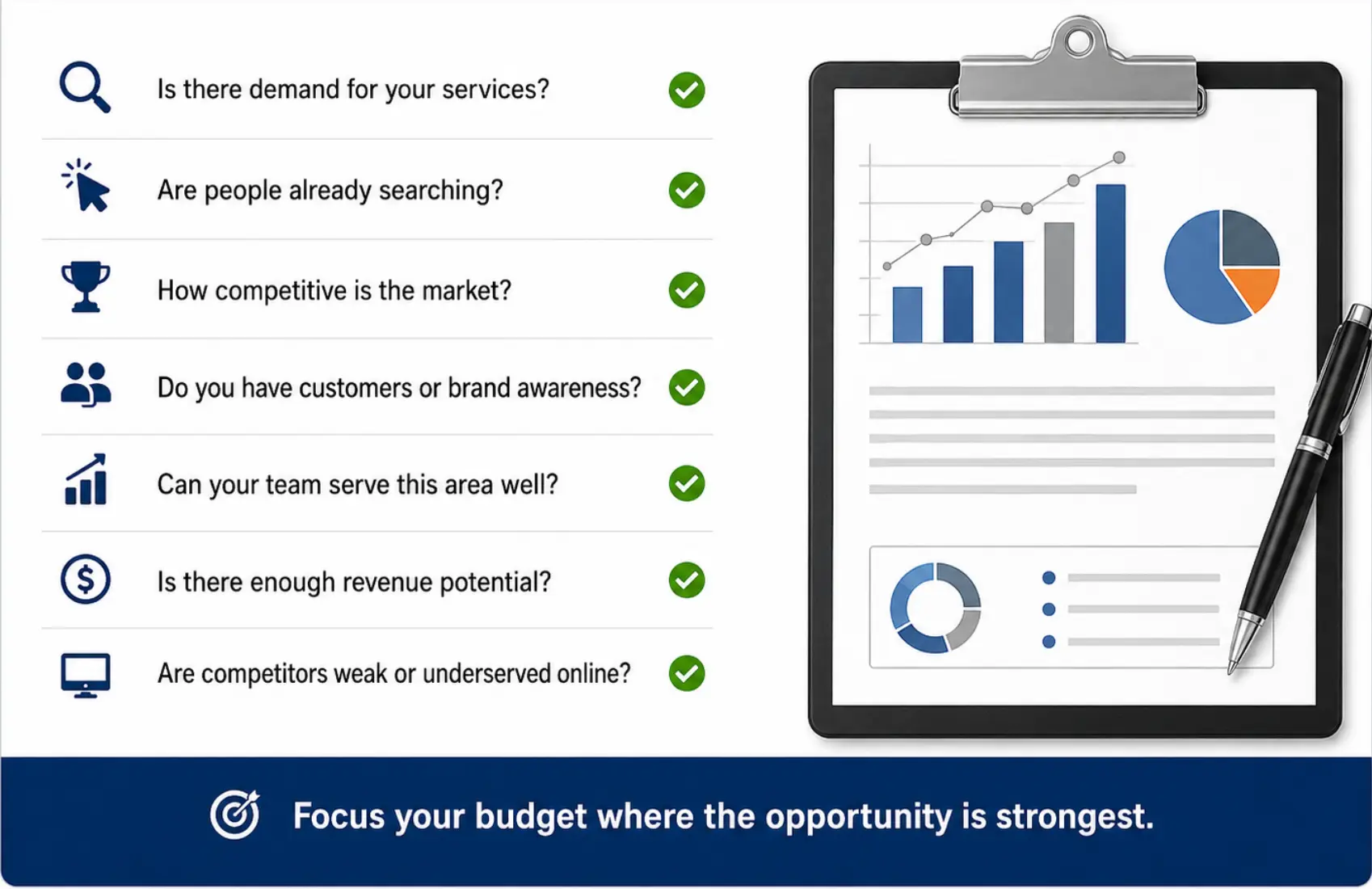
This step prevents businesses from spreading their budget too thin. Instead of trying to show up everywhere at once, a business should prioritize the markets with the best combination of demand, service capacity, and growth potential.
Build Market-Specific Messaging
One of the biggest mistakes growing businesses make is using the same message everywhere. Regional marketing works best when the core brand stays consistent, but the supporting message adapts to each market. A business may have the same services across multiple cities, but the reason people choose them may vary. In one market, speed and availability may matter most. In another, trust and reputation may be the deciding factor. Market-specific messaging helps your brand feel more relevant to each audience. The key is to avoid generic language like “serving your area” and instead communicate why your business is a strong choice for that specific market.
Create a Location Page Strategy
Location pages are one of the most important pieces of a regional marketing strategy. When done correctly, they help businesses rank in more cities, explain service availability, and create a better user experience for people searching in specific markets. However, location pages should not be thin, duplicated pages with only the city name swapped out. Each location page should be built with useful, locally relevant information. A strong regional location page may include:
- The specific services offered in that market
- Who the business serves in the area
- Nearby neighborhoods, counties, or service zones
- Local proof, testimonials, or case studies when available
- Clear calls to action
- Market-specific FAQs
- Internal links to related services
- Unique copy that reflects the local audience
- Trust signals such as reviews, credentials, photos, or project examples
For businesses without a physical location in every market, location pages still need to be accurate. The page should clearly communicate that the business serves the area, without pretending to have an office where it does not. This is especially important for SEO, user trust, and Google Business Profile compliance.
Align Service Pages and Location Pages
A regional SEO strategy should not rely on location pages alone. The strongest websites connect service pages and location pages together. Service pages explain what the business does. Location pages explain where the business provides those services. When these pages are properly connected through internal linking, search engines and users can better understand the relationship between services and markets.
For example, a regional moving company may need core service pages for local moving, long-distance moving, commercial moving, and storage. Then, each important market may need a location page that links back to the most relevant services. This creates a stronger website structure and helps avoid isolated pages that are hard for users and search engines to find.
Use Google Business Profiles Strategically
Google Business Profile can be a major driver of local visibility, especially for businesses with physical locations. For multi-location businesses, each legitimate location should have its own optimized profile with accurate business information, categories, services, photos, reviews, and posts.
For businesses that serve multiple areas from one location, the strategy is different. In that case, a service-area business setup may be more appropriate, and the website needs to do more of the work to support visibility across regional markets.
Either way, businesses should avoid creating Google Business Profiles for locations that do not meet Google’s guidelines. A regional strategy should be built for long-term visibility, not short-term shortcuts that risk suspension or trust issues.
Run Paid Media by Market, Not Just by Channel
Paid media can accelerate regional growth, but only when campaigns are structured with market intent in mind. A common mistake is running one broad campaign across every target city and assuming performance will be clear. Instead, regional businesses should consider segmenting campaigns by geography, audience intent, or market priority. This allows the business to better understand:
- Which markets are generating leads
- Which cities have the highest cost per conversion
- Where brand awareness is still low
- Which locations need more budget
- Where ad messaging should be adjusted
- Which markets are ready for more aggressive growth
Google Ads, paid social, programmatic advertising, and retargeting can all support regional expansion, but each channel plays a different role. Search campaigns are useful for capturing high-intent demand. Paid social can help introduce the brand to a new market and build familiarity. Programmatic and OTT can support awareness in larger regional campaigns. Retargeting can keep the business visible after someone visits the website but does not convert right away. The best regional paid media strategies do not treat every market the same. They use performance data to decide where to push, where to test, and where to pull back.
Build Trust Before Expecting Conversions
When a business enters a new market, people may not be ready to convert immediately. That does not mean the market is not valuable. It means the business needs to build trust. Regional marketing should include trust-building assets such as reviews, case studies, testimonials, educational content, community involvement, team photos, service explanations, and proof of results.
For example, if a dental practice is opening a new location, the campaign should do more than announce the opening. It should explain who the doctors are, what services are available, why the new location matters, and how patients can get started.
If a moving company is expanding into a new region, the strategy should show service reliability, local knowledge, reviews, process transparency, and proof that the company can handle moves in that market. People are more likely to contact a business when they feel familiar with the brand before they need the service.
Create Content for Regional Authority
Content plays an important role in helping businesses build authority across multiple markets. A regional content strategy can support both SEO and customer education by answering the questions people are asking before they make a decision. This may include:
- Market-specific service guides
- “Best time to” or “how to prepare” articles
- Local comparison content
- FAQs by service area
- Case studies from specific markets
- New location launch content
- Regional trend or planning articles
- Support content for high-value services
Content should not be created just to fill a blog calendar. It should support the larger regional growth strategy. The best content helps the business rank, builds trust, and gives sales or account teams useful resources to share with prospects.
Track Performance by Market
Regional marketing needs market-specific reporting. Overall website traffic is helpful, but it does not tell the full story. A business may see total traffic increase while one priority market underperforms. Or leads may increase overall, while a new market fails to gain traction. Regional reporting should look at performance by market whenever possible. Important metrics may include:
- Organic traffic by location page
- Keyword rankings by city
- Google Business Profile actions by location
- Paid media conversions by market
- Cost per lead by geography
- Form submissions by service area
- Phone calls by source or campaign
- Landing page conversion rates
- Review growth by location
- Engagement from regional content
This makes it easier to see where the strategy is working and where adjustments are needed. A regional strategy should evolve based on data, not assumptions.
Make Sure Your Website Can Convert Regional Traffic
Driving more traffic from new markets is only valuable if the website can convert that traffic into leads, calls, appointments, or sales. As businesses expand, their websites often need stronger conversion paths.
This may include:
- Clear market-specific calls to action
- Stronger contact forms
- Prominent phone numbers
- Service-area clarity
- Trust signals near conversion points
- Fast mobile performance
- Landing pages for paid campaigns
- FAQs that reduce hesitation
- Case study links
- Internal links to relevant services
A user arriving from a new market should quickly understand that the business serves their area, offers what they need, and is credible enough to contact. Regional growth does not end with visibility. It has to connect to conversion.
Common Regional Marketing Mistakes
Businesses often struggle with regional expansion when they treat it as a simple copy-and-paste version of local marketing.
Some of the most common mistakes include:
- Creating duplicate location pages with little unique value
- Targeting too many markets at once
- Running paid media without market-level tracking
- Using generic messaging across every city
- Ignoring Google Business Profile guidelines
- Failing to build trust in new markets
- Not connecting service pages and location pages
- Measuring only total traffic instead of market performance
- Expecting immediate conversions before building awareness
- Expanding marketing before confirming operational capacity
A strong regional strategy avoids these mistakes by creating a focused plan for where to grow, how to show up, and how to measure success.
How Renaissance Marketing Helps Businesses Grow Regionally
Renaissance Marketing helps growing businesses build regional marketing strategies that connect visibility, trust, and lead generation across multiple markets.
Our approach is not just about adding more location pages or launching more ads. It is about understanding where your business can grow, what each market needs, and how each platform should work together.
A regional marketing strategy may include:
- Market and competitor research
- Regional SEO strategy
- Location page planning
- Service page optimization
- Google Business Profile strategy
- Paid media campaign planning
- Content strategy
- Internal linking improvements
- Conversion rate optimization
- Review and trust signal recommendations
- Market-level reporting
- AEO and AI search visibility planning
For businesses expanding into new cities, regions, or locations, the right strategy can make growth more intentional and more measurable.
Regional Growth Requires a Market-by-Market Strategy
Expanding beyond one local market is a major opportunity, but it requires a thoughtful plan.
Regional marketing is not about being everywhere at once. It is about choosing the right markets, building local relevance, supporting visibility with strong SEO and paid media, and creating a website experience that turns regional traffic into real leads.
With the right regional marketing strategy, your business can move beyond one local market and build a stronger presence in every area you want to serve.
Ready to expand into your next market?
Renaissance Marketing can help you build a regional marketing strategy that connects your website, SEO, Google Business Profiles, paid media, content, and reporting into one growth plan.