
- Why Google Ads Behave Differently in the Dental Industry
- The Biggest Reasons Dental Practices Lose Money on Google Ads
- Keyword Strategy That Brings Real Patients
- Campaign Structure for Better Performance
- Writing Ads That Turn Clicks Into Calls
- Landing Pages: Where Most Dental Budgets Get Lost
- Budgeting and Bidding for Dental Google Ads
- Tracking Real ROI (Not Just Clicks)
- Google Ads vs. Other Dental Marketing Channels
- Should You Hire an Expert or Manage In-House?
- Ready to Get Started?
- FAQ
Across the dental industry, an estimated 20-30% of paid search spend is wasted on clicks that never lead to appointments. For a practice running even a modest $3,000-per-month campaign, that’s thousands of dollars lost each year on searches from people who were never going to become patients.
This guide is written for general dentists, orthodontists, and office managers who want Google Ads to work, not just run. Google Ads for dentists and orthodontists can deliver some of the strongest ROI in local marketing, but only when campaigns are structured, targeted, and managed with intention.
Why Google Ads Behave Differently in the Dental Industry
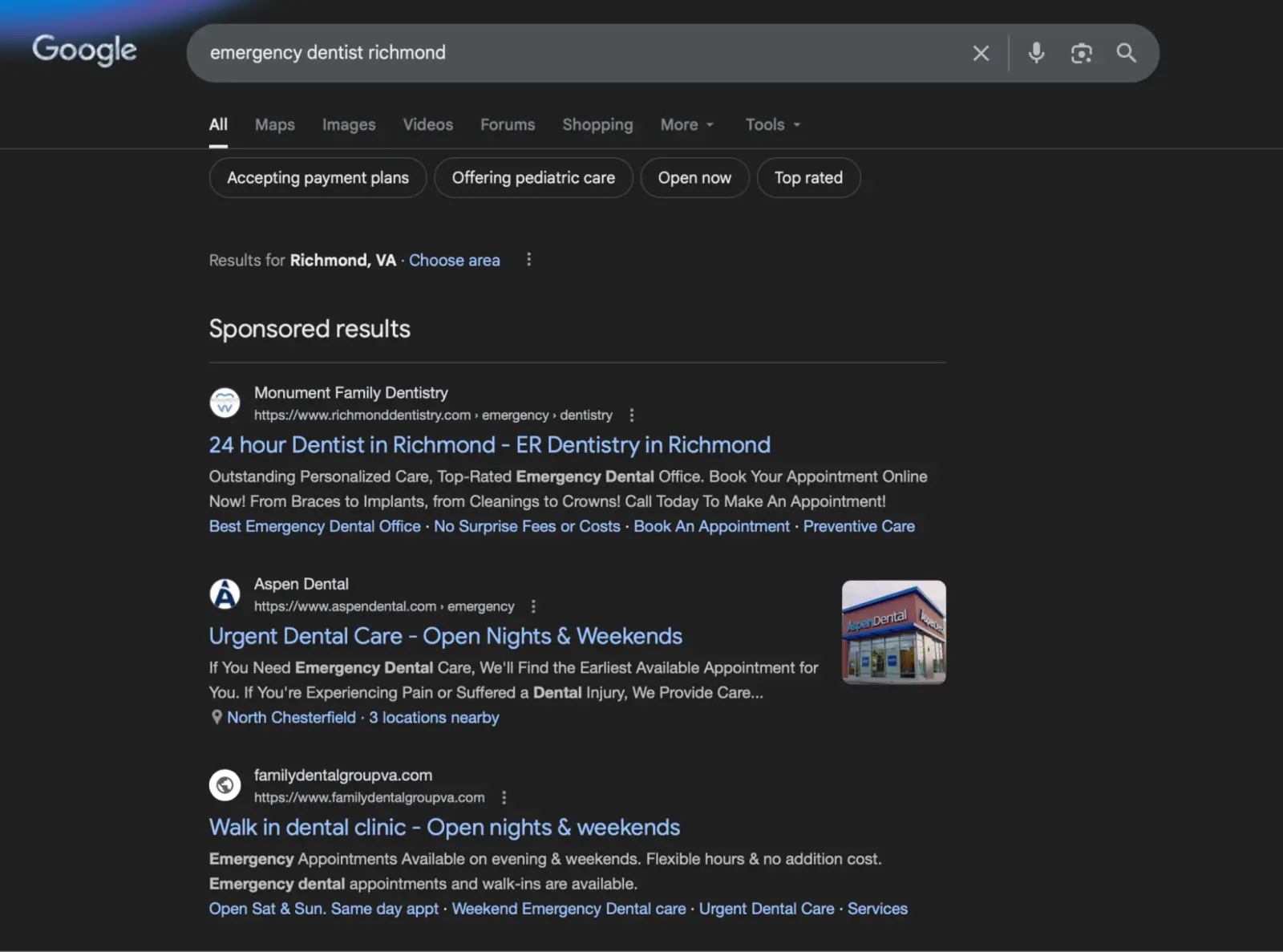
Dental search behavior is unusually high-intent. When someone types “emergency dentist Richmond, VA” or “Invisalign cost,” they’re not browsing. They have a specific need, often an urgent one, and they’re ready to act. That dynamic makes paid search particularly well-suited to dental practices.
Potential patients are typing in searches like:
- Dentist near me
- Teeth whitening near me
- Broken tooth emergency dentist
- Tooth repair Richmond VA
These patients are moments away from making a call or submitting a form, and that demand comes at a cost. Dental keywords are among the more competitive in local paid search, with average cost per click (CPC) ranging from $5 to $15 or more, depending on the market.
The Biggest Reasons Dental Practices Lose Money on Google Ads
Most wasted dental ad spend traces back to a handful of recurring mistakes.
- Using broad match without negative keywords. Broad match will serve your ads for searches like “free dental clinic” or “dental school near me” unless you explicitly exclude them. Every irrelevant click drains budget.
- Sending all traffic to the homepage. A homepage is built for every visitor. A patient searching for Invisalign needs a page built specifically for that service.
- Poor geographic targeting. Practices frequently pay for clicks from people well outside their service area. Precise radius targeting and location bid adjustments prevent this.
- No call tracking. Most dental conversions happen over the phone. Without call tracking, you can’t determine which keywords or ads are actually driving appointments.
- Set-and-forget management. Search terms shift, bids change, and ad fatigue sets in. Campaigns that aren’t reviewed regularly underperform quickly.
- Bidding on irrelevant queries. Searches tied to dental jobs, dental schools, or supply companies can trigger broad match ads. A well-maintained negative keyword list is non-negotiable.
Keyword Strategy That Brings Real Patients
High-intent keywords signal that a patient is ready to book. Low-intent keywords suggest general curiosity or research. The goal is to concentrate your budget on the former and build your negative keyword list around the latter.
Useful keyword categories for dental campaigns include:
Geography-based keywords
- dental implants [your city]
- teeth whitening near me
- porcelain veneers [your city]
Condition-based keywords
- broken tooth emergency dentist
- tooth pain relief dentist
- cracked tooth treatment
Service-based keywords
- Invisalign cost
- braces for adults
- smile makeovers
Long-tail keywords—more specific, multi-word queries like “affordable Invisalign orthodontist in Richmond”—typically cost less per click and convert at higher rates because they attract searchers with precise intent. They also tend to face less competition than shorter, more generic terms.
Treat your negative keyword list with the same strategic attention as your target keywords. Common exclusions include: free, insurance questions, job listings, dental school, and supply-related terms. Build and refine this list continuously.
Campaign Structure for Better Performance
Grouping all services into a single campaign makes optimization nearly impossible. When emergency dentistry, cosmetic procedures, orthodontics, and general cleanings share one budget and one set of settings, there’s no reliable signal for where your ad spend works hardest.
Ad scheduling matters more in dentistry than in most industries. Evenings and lunch breaks generate strong call volume because these are the moments when patients have a free window to act on a dental concern. Adjusting bids to capture those windows often improves efficiency meaningfully.
Device bidding also deserves attention. Dental searches skew heavily toward mobile. A patient with a toothache is far more likely to be searching from a phone than a desktop. For a practice in a market like Tampa, FL, mobile clicks may represent 65-70% of total traffic, and mobile users frequently convert via phone call rather than a form fill.
Writing Ads That Turn Clicks Into Calls
Strong dental ads do three things: Identify the service clearly, connect with the patient’s emotional state, and give a concrete reason to act now. A headline like “Same-Day Emergency Dentist” paired with “Pain Relief Today — Call Us” works because it addresses urgency rather than just listing a service.
Emotional triggers in dental advertising tend to center on pain relief, confidence, affordability, and convenience. Leaning into those themes makes ads feel relevant rather than generic.
Ad extensions increase click-through rates and cost nothing additional per click:
- Call extensions make your phone number clickable directly from the search results page.
- Location extensions display your address and reinforce local relevance.
- Sitelinks offer additional paths: Book Online, See Financing Options, View Before & Afters.
- Callouts surface quick facts: Same-Day Appointments, Accepting New Patients, In-Network Insurance.
A/B testing ad copy is an ongoing discipline. Running two headline variations simultaneously reveals what resonates with your specific patient base over time. Small copy changes can produce meaningful differences in conversion rates.
Landing Pages: Where Most Dental Budgets Get Lost
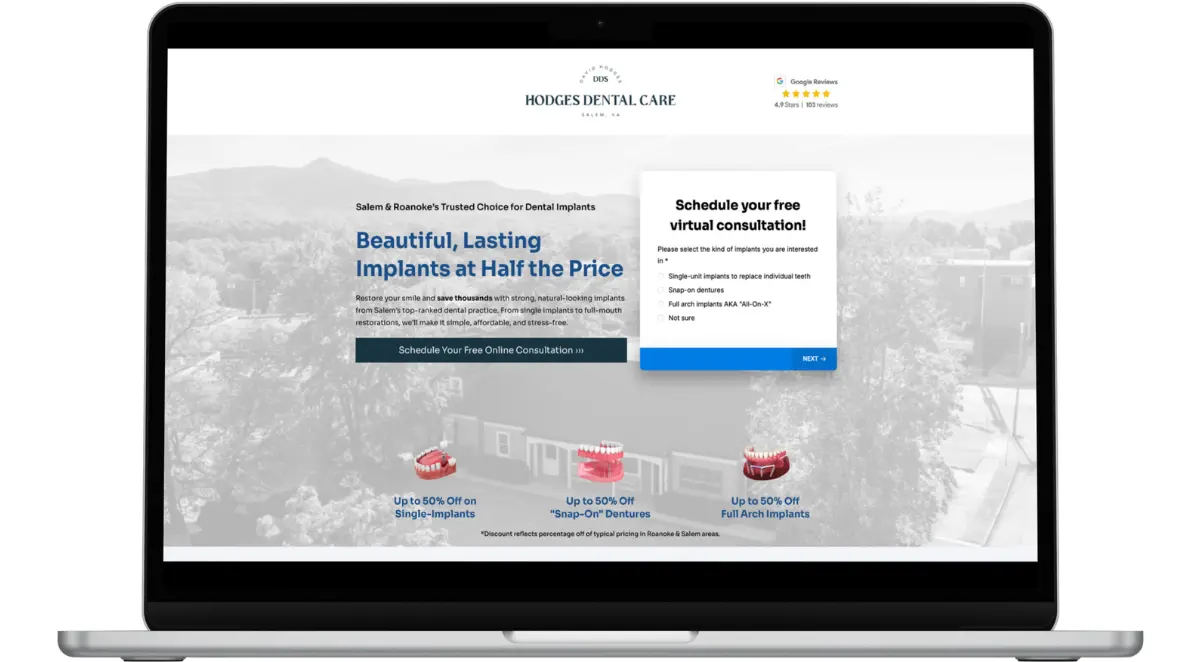
Sending paid traffic to your homepage is one of the most common and costly errors in dental advertising. A homepage serves every visitor. A dedicated landing page serves one searcher with one specific need, and that focus drives conversions.
Effective dental landing pages include:
- A single, clear CTA: one phone number or one booking form, not multiple competing options
- Patient reviews and recognizable trust signals, like Google reviews and before-and-after photos
- Fast mobile load speed, because pages that take longer than three seconds lose a significant share of mobile visitors
- Messaging that directly mirrors the keyword and ad that the patient clicked on
Budgeting and Bidding for Dental Google Ads
Budget requirements vary by market. A practice in a smaller market competing for local terms may see strong results at $1,500 per month. A multi-location group in a competitive metro may need $5,000 or more just to maintain meaningful visibility.
Manual CPC gives experienced managers granular control over bids at the keyword level. Smart Bidding strategies like Target CPA work well once campaigns have enough conversion data (typically 30 or more conversions per month) for the algorithm to optimize reliably. Setting up Smart Bidding too early, before that data exists, usually backfires.Patient lifetime value should anchor your cost-per-lead targets. A new patient who stays with your practice and accepts recommended treatment over several years represents substantial revenue. If the average patient lifetime value is $3,000, spending $150 to $250 to acquire them is a sound investment. That calculation makes your acceptable cost-per-lead concrete rather than abstract.
Tracking Real ROI (Not Just Clicks)
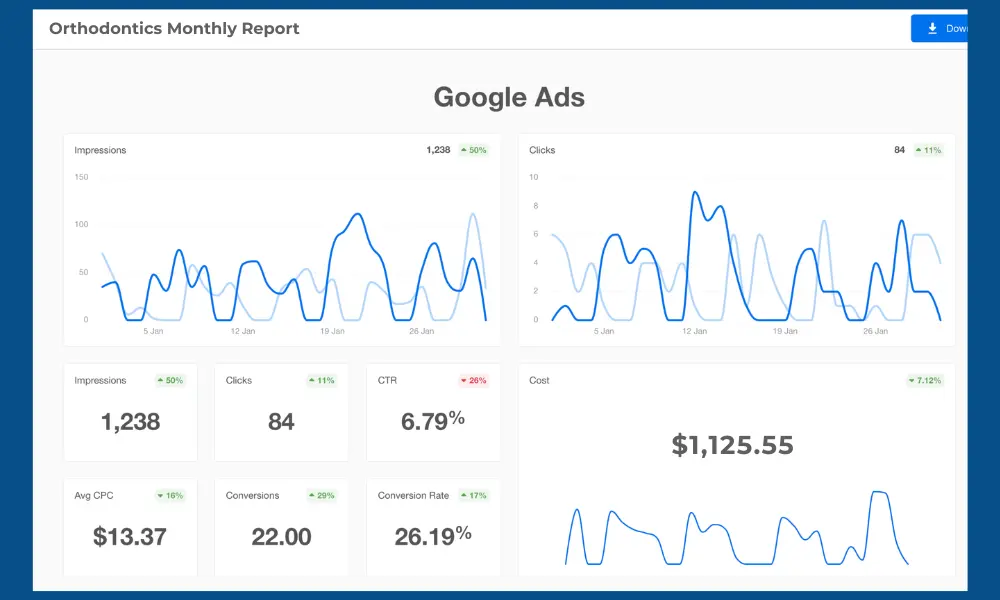
Clicks and impressions are not performance metrics. The numbers that matter in dental advertising are cost per lead, cost per new patient, and return on ad spend.
Proper tracking setup requires:
- Call tracking software (such as CallRail) that attributes phone calls to specific keywords and ads
- Form submission tracking via Google Ads conversion tags or Google Analytics goals
- Online booking integrations tagged as conversion events where applicable
Without this infrastructure in place, evaluating whether your dental PPC services are actually working is guesswork—and guesswork can only take your practice so far.
Google Ads vs. Other Dental Marketing Channels
Each channel plays a different role in patient acquisition:
- Google Ads captures high-intent searches immediately. Results are near-instant, but costs stop when spending stops.
- SEO builds durable organic visibility over time. It takes longer to produce results, but it expands your reach exponentially the longer you work at it.
- Facebook Ads reach patients at the awareness stage. Useful for brand-building and retargeting, but intent is lower than search.
- Google Local Services Ads (LSAs) appear above traditional search ads with a “Google Guaranteed” badge. They operate on a pay-per-lead model rather than pay-per-click, which some practices find more predictable.
Combining Google Ads with local SEO tends to outperform either channel alone. Paid ads deliver immediate visibility while organic rankings build over time, reducing long-term dependence on ad spend. LSAs can complement traditional search campaigns by capturing the top-of-page placement with a different pricing model.
Should You Hire an Expert or Manage In-House?
Signs campaigns need professional help
If you’re spending more than $1,000 per month without clear visibility into cost per lead, if your search term reports include large volumes of irrelevant queries, or if campaigns have gone weeks without optimization, professional management is likely to pay for itself quickly.
Questions to ask a dental PPC agency
- Do you manage campaigns specifically for dental or healthcare clients?
- Can you share examples of cost-per-lead improvements you’ve achieved for other clients?
- How do you handle call tracking and attribution?
- What does your reporting include, and how often do we review performance?
Red flags
- No case studies or documented results for dental clinics
- Promises of guaranteed placement or specific click volumes
- Locked-in contracts with no performance accountability
- Reporting that focuses on impressions and clicks rather than leads and appointments
Basic DIY tips for small practices
If budget limits professional management, start with a tightly scoped campaign: one service, one geographic radius, exact and phrase match only, a robust negative keyword list, and a dedicated landing page. Keep daily budgets low until you have enough data to optimize. Review search term reports weekly and add negatives consistently.
Ready to Get Started?
Google Ads for dentists and orthodontists works. The practices that see real returns treat it as a managed system, not a set-it-and-forget-it channel. Proper campaign structure, keyword strategy, landing page alignment, and conversion tracking are what separate profitable campaigns from money-draining ones.
If your current campaigns aren’t delivering measurable results, an audit is a reasonable starting point. A strategy call with a team that understands dental PPC services can surface exactly where your budget is being lost and what it would take to fix it.
FAQ
Are Google Ads worth it for dentists?
Yes, when managed properly. Dental searches are high-intent and local, which makes paid search one of the more efficient patient acquisition channels available. The key variables are campaign structure, keyword targeting, and landing page quality. Poorly managed campaigns waste money; well-managed ones generate consistent appointment flow.
How long does it take to see results?
Most practices see meaningful data within the first 30 to 60 days. Initial results help establish baseline metrics (cost per click, conversion rate, cost per lead) that inform ongoing optimization. Campaigns typically improve month over month as data accumulates and settings are refined.
What is a good cost per lead for dental PPC?
It depends on the service and market. General appointment leads may run $40 to $80. Higher-value services like implants or full orthodontic cases often justify a cost per lead of $100 to $200 or more, given the revenue each patient represents. The metric that matters most is cost per new patient relative to lifetime patient value.
Should orthodontists use search or display ads?
Search ads are the higher priority for Google Ads for orthodontists because they reach patients actively looking for treatment. Display ads can support brand awareness by reaching people who visited your site without making an appointment, but they’re unlikely to drive new patients on their own.
Can small dental clinics compete with big practices?
Yes, with smarter targeting. Large practices often compete broadly; smaller clinics can outperform them in specific service categories or zip codes by being more precise. Tight geographic targeting, long-tail keywords, and dedicated landing pages level the playing field considerably. Spend efficiency beats raw budget when campaigns are well-structured.