
- Why HVAC Contractors Cannot Afford to Ignore Google Ads
- The Four Types of Google Ads HVAC Contractors Should Know
- Google Local Service Ads for HVAC
- Google Search Ads (PPC) for HVAC
- Local Service Ads vs. Google Search Ads for HVAC: Which One Wins?
- Why the Best HVAC Companies Use Both LSAs and Google Search Ads
- How to Adjust Your HVAC Google Ads Strategy by Season
- Common HVAC Google Ads Mistakes to Avoid
- How Much Should an HVAC Company Spend on Google Ads?
- FAQ About HVAC Google Ads
- Do Google Ads work for small HVAC companies?
- How long does it take to see results from Google Ads?
- Can I run Google Ads myself, or do I need an agency?
- What is the Google Guaranteed badge, and how do I get it?
- How do I dispute a bad LSA lead?
- Should I run ads year-round or only during peak season?
- What is a good cost per lead for HVAC?
- How do I track which Google Ads are generating actual booked jobs?
- Are Google Ads better than Facebook Ads for HVAC?
If you run an HVAC company, there is a good chance your phone goes quiet between service calls, surges through summer and winter, and slows to a crawl during shoulder seasons. Google Ads for HVAC can change that pattern significantly. When set up correctly, they put your business in front of homeowners and property managers at the exact moment they are searching for help, whether that is an emergency AC repair on a hot July afternoon or a furnace tune-up before the first cold snap.
This guide covers everything HVAC contractors need to know: the different ad types available, how they work, what they cost, and how to build a strategy that generates real leads year-round.
Why HVAC Contractors Cannot Afford to Ignore Google Ads
HVAC is one of the most searched service categories on Google. When a homeowner’s air conditioning fails at 7 p.m. in August, they are not scrolling social media or waiting for a mailer to arrive. They are searching Google, and they are going to call whoever shows up at the top.
Organic SEO is valuable for long-term visibility, but it takes time. Google Ads delivers top-of-page placement immediately, with complete control over budget, targeting, and messaging. For HVAC companies competing in crowded local markets, that visibility is not a luxury. It is a growth lever.
The contractors who consistently win market share are the ones who appear when demand spikes. Google Ads makes that possible.
The Four Types of Google Ads HVAC Contractors Should Know
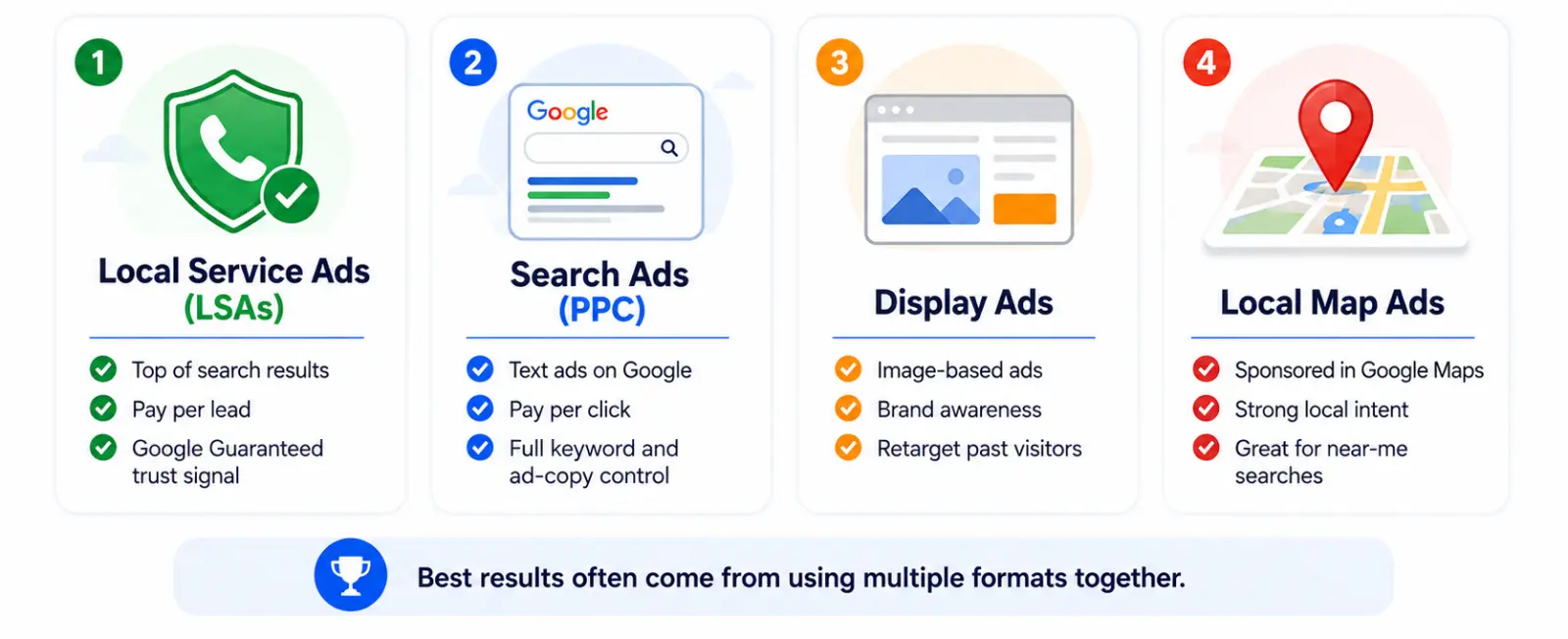
Not all Google Ads work the same way. HVAC companies have access to four main ad formats, each with its own placement, cost structure, and use case.
Local Service Ads (LSAs)
LSAs appear at the very top of Google search results, above traditional paid ads. They display your business name, rating, and phone number, and you only pay when a potential customer contacts you directly through the ad. Contractors must pass a background check and Google verification process to qualify.
Google Search Ads (PPC)
Search ads are text-based ads that appear above organic results. You bid on keywords, and your ad shows when someone searches for terms that match. You pay per click, regardless of whether the visitor ultimately calls or books.
Google Display Ads
Display ads are image-based banners that appear across Google’s network of partner websites. For HVAC, they work best for brand awareness and retargeting, reaching homeowners who have already visited your site but have not yet converted.
Google Local Map Ads
Local map ads appear inside Google Maps search results, marked as “Sponsored.” They show your business name, rating, and address. These ads are well-suited for contractors who want to capture searches with strong local intent, such as “HVAC repair near me.”
Google Local Service Ads for HVAC
HVAC Local Service Ads operate differently from every other Google ad format. Instead of paying for clicks, you pay for leads, defined as phone calls or messages that come directly through the ad.
This pay-per-lead structure appeals to contractors who want predictable cost control. You set a weekly budget, and Google distributes your ads based on availability, review ratings, and proximity to the searcher.
To qualify, your business must complete Google’s screening process, which includes a background check, license verification, and insurance confirmation. Approved businesses earn the Google Guaranteed badge, a trust signal displayed directly in the ad. For a detailed walkthrough of how the program works, this overview of Google Local Services Ads covers the full setup and verification process.
Pros and Cons of LSAs for HVAC
Pros:
- You pay for leads, not clicks
- The Google Guaranteed badge builds immediate trust with searchers
- Placement appears above all other search ads
- Simpler to set up and manage than a full PPC campaign
Cons:
- Limited control over which searches trigger your ad
- No keyword targeting or custom ad copy
- Lead quality can vary, and disputes require active management
- Not available in all markets or for all business types
How Much Do HVAC LSAs Cost?
LSA costs depend on your market, competition, and the type of job. Cost per lead typically ranges from $20 to $80, though emergency repair leads in competitive metro areas can exceed $100. Google allows you to dispute clearly invalid leads, such as wrong-number calls or inquiries for services outside your coverage area, which can bring your actual average lead cost down over time.
Google Search Ads (PPC) for HVAC
Search ads give HVAC contractors significantly more control than LSAs. You choose your keywords, write your own ad copy, set your own bids, and direct traffic to a specific landing page. That flexibility makes PPC a powerful tool for capturing high-value searches and testing different offers throughout the year.
How Search Ads Work
When someone searches “AC repair” or “emergency furnace replacement,” Google runs an auction. Your ad’s position is determined by your bid and your Quality Score, which measures ad relevance, expected click-through rate, and landing page experience. A well-structured campaign with a strong landing page can outperform a competitor with a higher bid.
Pros and Cons of Search Ads for HVAC
Pros:
- Full control over keywords, messaging, and landing pages
- Scalable across service areas and markets
- Effective for promoting specific services, seasonal offers, and maintenance plans
- Rich performance data for ongoing optimization
Cons:
- You pay per click, whether or not the visitor converts
- Requires ongoing management and testing
- HVAC keywords rank among the most expensive in local PPC
- Poor campaign structure can drain budget without producing results
Writing HVAC Ad Copy That Gets Clicks
The most effective HVAC ads are direct, specific, and give the searcher a reason to act immediately. Lead with the service, include a concrete differentiator (same-day availability, 24/7 response, financing options), and end with a clear next step. Avoid vague language and phrases that every competitor uses. Think about why your business is different, and speak to that.
Headlines that tend to perform:
- AC Repair Same Day | Labor Warranty | Call Now
- Furnace Replacement Estimates | Financing Available
- 24/7 Emergency HVAC | No Extra After-Hours Fees
HVAC Landing Pages That Convert Clicks into Calls
Clicks are only valuable if they lead somewhere that converts. A generic homepage is not a landing page. Each PPC campaign needs a focused destination that matches the ad’s specific promise, loads fast on mobile, puts a phone number above the fold, and removes every possible friction point. A page that answers “can they help me, and how do I reach them?” in under five seconds will consistently outperform one that makes the visitor hunt for information.
Bidding Strategies for HVAC Search Ads
New campaigns typically benefit from manual cost-per-click bidding, which gives you clear visibility into what you are paying at the keyword level. As the campaign accumulates conversion data, smart bidding strategies like Target CPA or Maximize Conversions can improve efficiency. Avoid switching bidding strategies too early. Google’s algorithm needs enough conversion history before it can optimize reliably.
Local Service Ads vs. Google Search Ads for HVAC: Which One Wins?
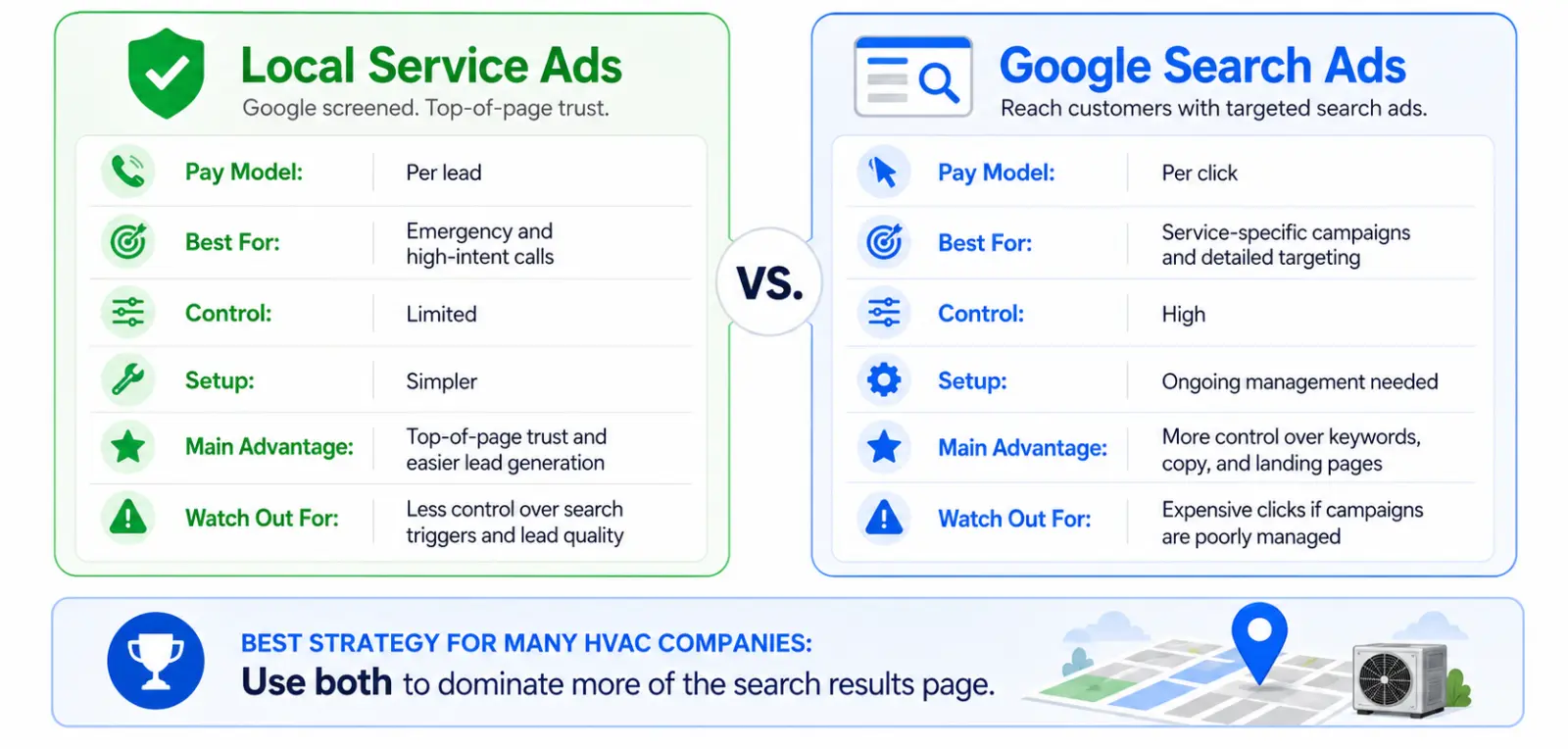
Neither format dominates the other outright. They serve different purposes, and the right choice depends on your goals and operational capacity.
When LSAs Are the Right Choice
LSAs make sense when you are new to Google advertising and want a straightforward entry point with predictable lead costs. They are also a good fit for contractors who lack the bandwidth to manage a full PPC campaign, or who primarily want to capture emergency and high-intent service calls without building out campaign infrastructure.
When Search Ads Are the Right Choice
Search ads are the stronger option when you want control over messaging, need to target specific services or geographies, or are ready to invest in a more sophisticated strategy. They are also more effective for promoting system installations, maintenance agreements, and seasonal offers, situations where the searcher is not in crisis mode and responds to more detailed messaging.
Which Delivers Better ROI for HVAC?
ROI depends heavily on execution. A well-managed PPC campaign typically delivers a lower cost per booked job over time because the entire click-to-call journey can be optimized. LSAs can deliver competitive ROI with less overhead, but limited placement control and lead quality variability introduce risk that is harder to manage at scale.
Why the Best HVAC Companies Use Both LSAs and Google Search Ads
The HVAC contractors with the strongest lead pipelines do not pick one format and commit to it exclusively. They run both. LSAs capture top-of-page intent from searchers who prefer clicking a verified, trust-badged listing. PPC captures those who scroll slightly further, compare options, or are looking for something specific, such as a particular equipment brand or a company that offers financing.
Together, they create a more complete presence across the Google search results page.
The HVAC Advertising Stack (What a Full Google Ads Strategy Looks Like)
A comprehensive Google Ads management strategy for an HVAC company typically includes:
- LSAs for high-intent, top-of-page lead capture
- Search campaigns targeting service-specific and emergency keywords
- Display retargeting to re-engage site visitors who did not initially convert
- Seasonal budget shifts tied to demand patterns
- Call tracking and lead attribution that ties ad spend to actual revenue
How to Measure Success Across Both Platforms
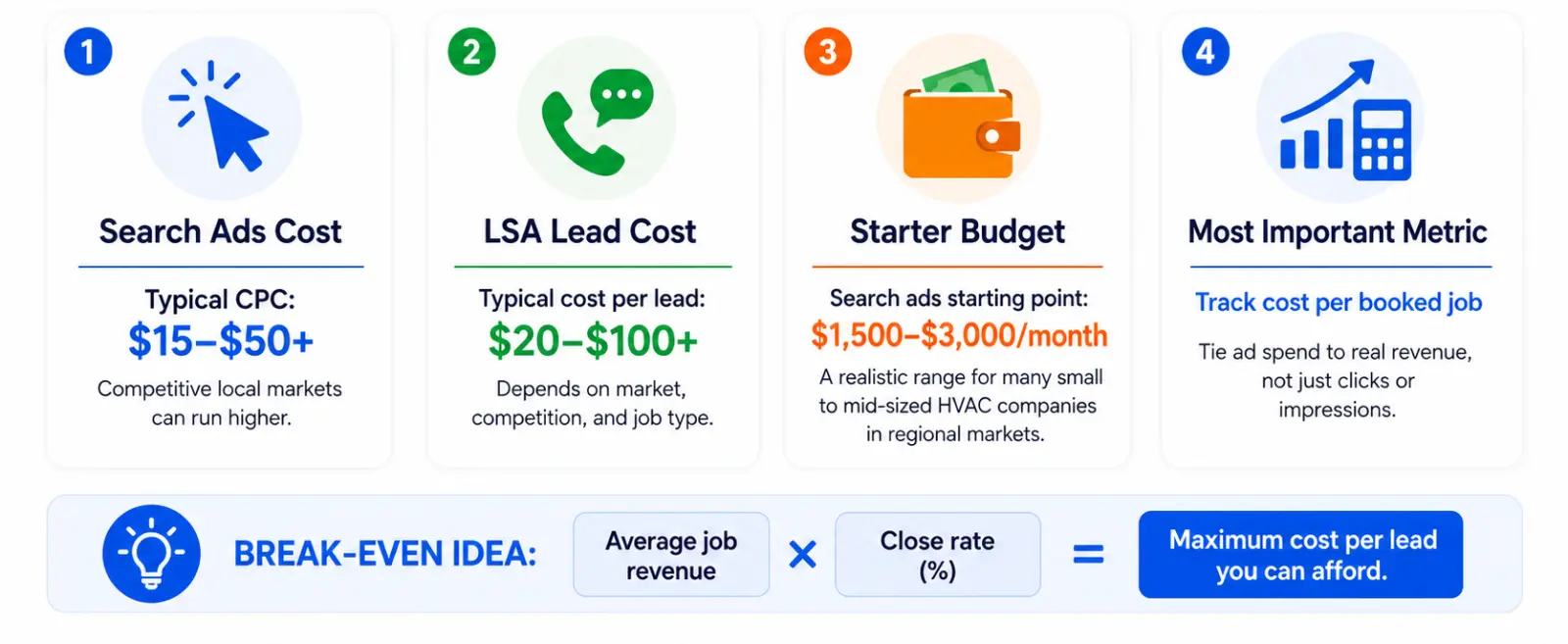
The most important metric is not clicks or impressions. It is the cost per booked job. Track every lead source, record call outcomes, and connect your Google Ads data to your dispatch or CRM system. If you are spending $1,500 per month across both platforms and booking consistent, profitable jobs from that spend, the return is clear. Without that connection, you are guessing.
Get professional Google Ads management from Renaissance Marketing.
How to Adjust Your HVAC Google Ads Strategy by Season
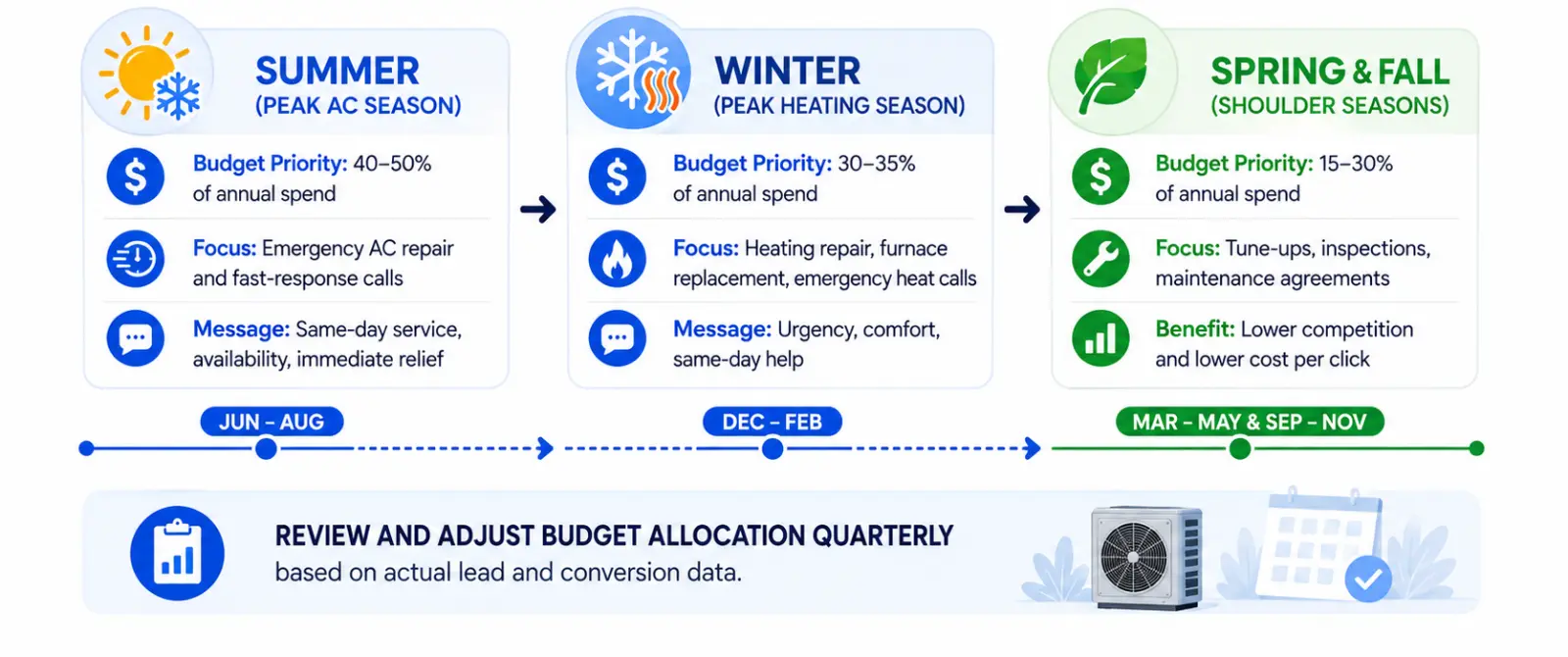
Demand for HVAC services follows predictable seasonal patterns, and your ad strategy should follow the same rhythm.
Summer (Peak AC Season)
Increase budgets and prioritize emergency repair keywords. Competition peaks from June through August, so bids rise accordingly. Focus ad copy on speed, availability, and immediate relief. This is the season where every dollar of ad spend carries the most potential return.
Winter (Peak Heating Season)
Shift budget and keyword focus to heating repair, furnace replacement, and emergency heat calls. Search behavior mirrors summer but centers on a different system. Ads that lead with urgency and same-day availability consistently perform well during this period.
Spring and Fall (Shoulder Season)
These months are ideal for promoting tune-ups, system inspections, and maintenance agreements. Competition drops, cost per click decreases, and budget stretches further. Shoulder seasons are also an opportunity to lock in recurring revenue before peak demand returns.
Seasonal Budget Planning Framework
A practical starting point: allocate 40 to 50 percent of your annual Google Ads budget to summer, 30 to 35 percent to winter, and the remaining 15 to 30 percent to shoulder seasons. Review that allocation quarterly and adjust based on actual lead volume and conversion data from prior periods.
Common HVAC Google Ads Mistakes to Avoid
- Running ads without conversion tracking. If Google cannot see which clicks turn into leads, it cannot optimize for them, and neither can you.
- Using broad match keywords without a negative keyword list. Broad match will trigger ads for searches that have nothing to do with your business, draining your budget without producing leads.
- Sending all traffic to your homepage. Every campaign deserves a targeted landing page that matches the specific ad.
- Setting campaigns and walking away. Even a well-structured campaign degrades without regular review.
- Ignoring mobile performance. The majority of emergency HVAC searches happen on smartphones. If your landing page does not load quickly and function cleanly on mobile, those callers are going to a competitor.
How Much Should an HVAC Company Spend on Google Ads?
Budget decisions depend on your market, your goals, and the types of campaigns you are running. There is no single universal answer, but there are frameworks that make the decision more concrete. For a broader look at how to approach ad spend, this guide on PPC budget and management fees is a useful reference.
What HVAC Advertising Actually Costs
HVAC Google Ads cost more per click than many other industries. Keywords like “emergency AC repair” or “furnace replacement near me” can range from $15 to $50 per click in competitive markets, and that figure goes higher in large metro areas. LSA lead costs generally fall between $20 and $100, depending on the market and job type.
Recommended Starter Budgets
For a small to mid-sized HVAC company in a regional market, a starting monthly budget of $1,500 to $3,000 for search ads is realistic. Smaller markets may require less to generate meaningful lead volume; larger metros may require more. LSAs can run alongside your search campaigns with a separate weekly budget and will not typically compete with or undercut your PPC performance.
How to Calculate Your Break-Even Cost Per Lead
Start with your average revenue per booked job. Multiply by your close rate, the percentage of leads you convert to actual booked work. Then divide to find the maximum you can spend per lead and still break even. For example, if your average job generates $800 in revenue and you close 60 percent of leads, each lead represents roughly $480 in potential value. A cost per lead of $80 to $100 still leaves substantial room for margin.
FAQ About HVAC Google Ads
Do Google Ads work for small HVAC companies?
Yes. Ad placement is based on bid quality and campaign structure, not company size. A two-truck operation with a well-built campaign and a strong landing page can outperform a regional chain that is spending more but managing poorly.
How long does it take to see results from Google Ads?
LSAs can generate leads within days of going live. Search ads typically need two to four weeks to accumulate meaningful data and begin optimizing toward conversions. Full campaign maturity, where automated bidding is reliable and performance is stable, generally takes two to three months.
Can I run Google Ads myself, or do I need an agency?
You can set up Google Ads without outside help, but running them profitably requires time and a real learning curve. Common DIY mistakes include overly broad keyword targeting, weak landing page setup, and missing conversion tracking. For most HVAC companies, the return from working with an experienced agency outweighs the management cost relatively quickly.
What is the Google Guaranteed badge, and how do I get it?
The Google Guaranteed badge appears in LSA listings and signals that Google has verified your business license, insurance, and background check. If a customer is dissatisfied with a job booked through an LSA, Google may offer a reimbursement up to a set limit. Earning the badge requires completing Google’s screening process through the LSA platform.
How do I dispute a bad LSA lead?
Inside your LSA dashboard, you can flag individual leads as invalid. Acceptable dispute reasons include calls from outside your service area, calls for services you do not offer, and duplicate leads. Google reviews each dispute and will credit your account for leads that meet their criteria.
Should I run ads year-round or only during peak season?
Year-round is almost always the stronger strategy. Shoulder season ads cost less per click and generate maintenance, tune-up, and replacement leads that keep your schedule productive outside of peak periods. Running ads only during summer and winter means your competitors own the market every other month.
What is a good cost per lead for HVAC?
A reasonable benchmark for most markets is $40 to $100 per lead. What matters more than any benchmark is how your cost per lead compares to your revenue per booked job. A $90 lead that converts to a $2,000 system installation is an excellent return by any measure.
How do I track which Google Ads are generating actual booked jobs?
Use call tracking numbers that are unique to each campaign, integrate your CRM or dispatch software with your lead data, and tag form submissions with UTM parameters so you can trace them back to the source campaign. That connection between marketing input and revenue output is what allows you to invest confidently rather than guess.
Are Google Ads better than Facebook Ads for HVAC?
For capturing high-intent service demand, Google Ads consistently outperform Facebook. People do not go to Facebook when their furnace stops working. They go to Google. Facebook can play a supporting role for brand awareness, seasonal promotions, and maintenance plan marketing, but it should not serve as the primary lead generation channel for most HVAC businesses.