
- Results Snapshot – AI SEO Outcomes
- The Challenge – Why AI SEO Matters Now
- Objectives
- Where We Showed Up in AI
- AI SEO Visibility Results
- What We Did – The Renaissance Marketing AI SEO Framework
- Why This Worked – How AI Systems Decide Who to Mention
- Key Takeaways for Local Businesses
- Our New Service — AI SEO with Renaissance Marketing
- Get Listed Across AI LLMs with Renaissance Marketing Today
- AI SEO FAQs
If you’ve noticed fewer clicks coming from traditional search (even when rankings are solid), you’re not imagining things. The way people discover local providers is shifting fast. Instead of comparing ten blue links, they’re asking AI questions like:
- “Who are the best social media marketing agencies in Tampa?”
- “What’s a good marketing agency in Richmond, VA?”
- “Who should I hire for SEO and paid ads?”
That’s exactly why Renaissance Marketing focused on AI SEO—not as a replacement for traditional SEO, but as the missing layer that helps you get named in AI-generated recommendations across Google and major LLMs like ChatGPTand Gemini.
This case study shows how we earned AI visibility in two target markets—Tampa, Florida and Richmond, Virginia—with screenshot evidence from Google AI and ChatGPT, plus AI visibility trends from Semrush.
Results Snapshot – AI SEO Outcomes
Here’s the “quick read” version before we get into the how.
We earned visibility across multiple AI surfaces where people are actively looking for agencies, and Semrush’s AI Visibility reporting reflected growth in mentions, citations, and reach.
Highlights:
- Markets: Tampa, FL + Richmond, VA
- AI surfaces: Google AI Overview, Google AI Mode, ChatGPT, Gemini
- Semrush AI Visibility:
- Monthly Audience: 2.3M (+1.9M)
- Mentions: 59 (+22)
- Cited Pages: 46 (+6)
- Mentions by surface: ChatGPT (7), AI Overview (37), AI Mode (5), Gemini (10)
What’s important here isn’t just the raw counts, it’s the pattern: multiple surfaces, multiple mentions, multiple cited pages. That’s how you build durable AI visibility instead of a one-off appearance.
The Challenge – Why AI SEO Matters Now
Traditional SEO is still foundational, but the “decision moment” is increasingly happening before a user clicks a website.
Google’s AI Overviews can summarize the market and list options. AI Mode can pull in business details. LLMs can recommend providers, cite sources, and shape buyer preferences. That means a local business can be doing “fine” in classic SEO and still lose mindshare if they’re not showing up in AI answers.
For Renaissance Marketing, the challenge was clear:
- Compete in two distinct local markets (Tampa + Richmond)
- Earn inclusion in AI-generated shortlists
- Make sure AI systems had enough confidence and clarity to mention the brand consistently (not occasionally)
Objectives
Primary goals
- Show up in AI answers for local, high-intent searches like “best social media marketing agency” + city
- Strengthen Renaissance Marketing’s entity recognition so AI systems understand who we are, what we do, and where we serve
- Build a repeatable AI SEO framework that can be applied to other clients and verticals, including multi-location brands
What “showing up in AI” means in this case study
In this case study, “showing up” isn’t vague. It means Renaissance Marketing was listed, recommended, or surfaced in AI-generated results (Google AI Overview/AI Mode) and/or LLM outputs (ChatGPT/Gemini), and we can point to screenshots as proof.
Where We Showed Up in AI
This is the most important part of the case study, because it moves the conversation from “AI SEO sounds cool” to “Here’s what it looks like in the real world.”
Tampa, Florida (Google AI Overview + ChatGPT)
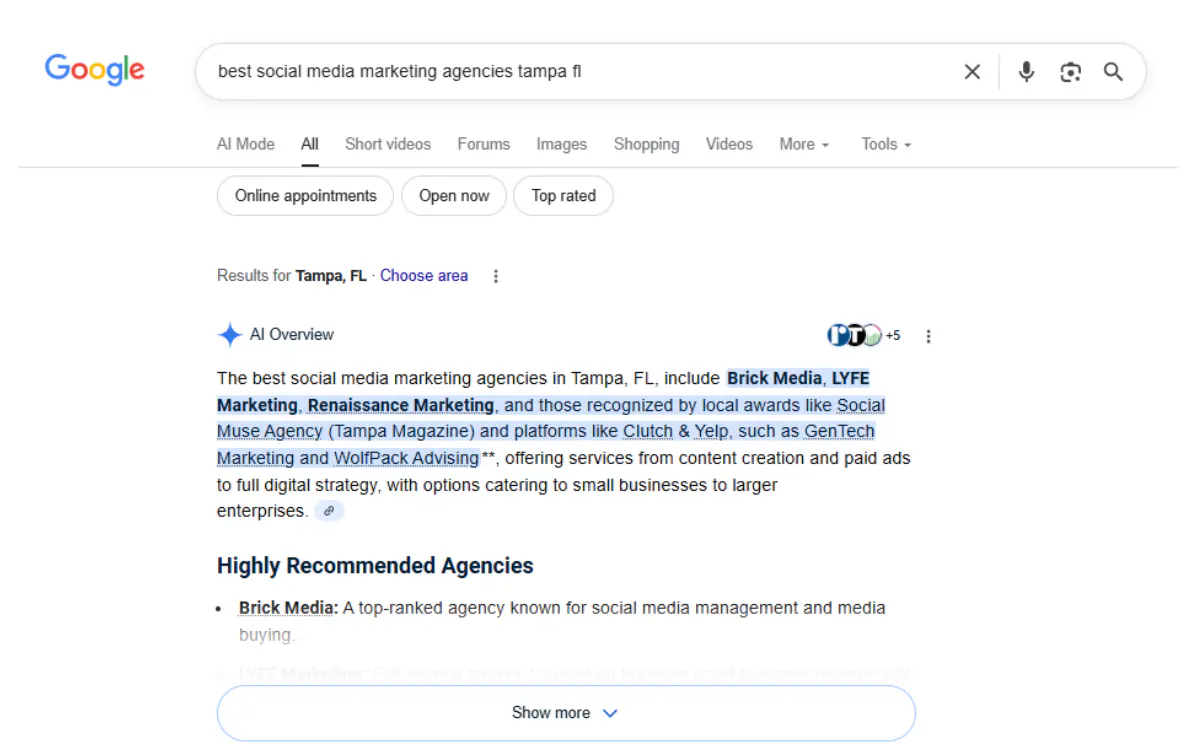
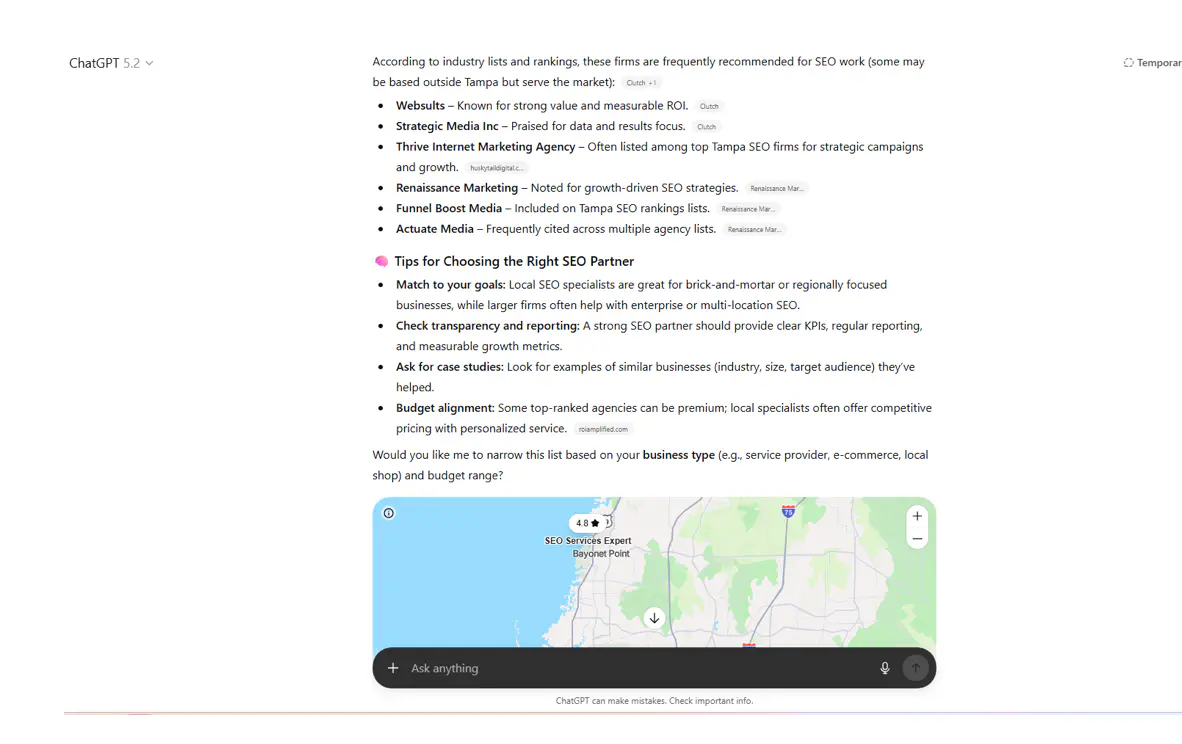
For Tampa, the screenshots show Renaissance Marketing appearing in AI-driven results when users searched for top agencies.
What the screenshots show:
- In Google AI Overview for the query “best social media marketing agencies tampa fl”, Renaissance Marketing appears in the shortlist of recommended agencies.
- In ChatGPT results for Tampa-related agency discovery, Renaissance Marketing is included in the recommended set as well.
This matters because these are the exact moments where prospects are most likely to convert: they’re not browsing casually, they’re looking for the “best option” and ready to choose.
Richmond, Virginia (Google AI Mode + ChatGPT)
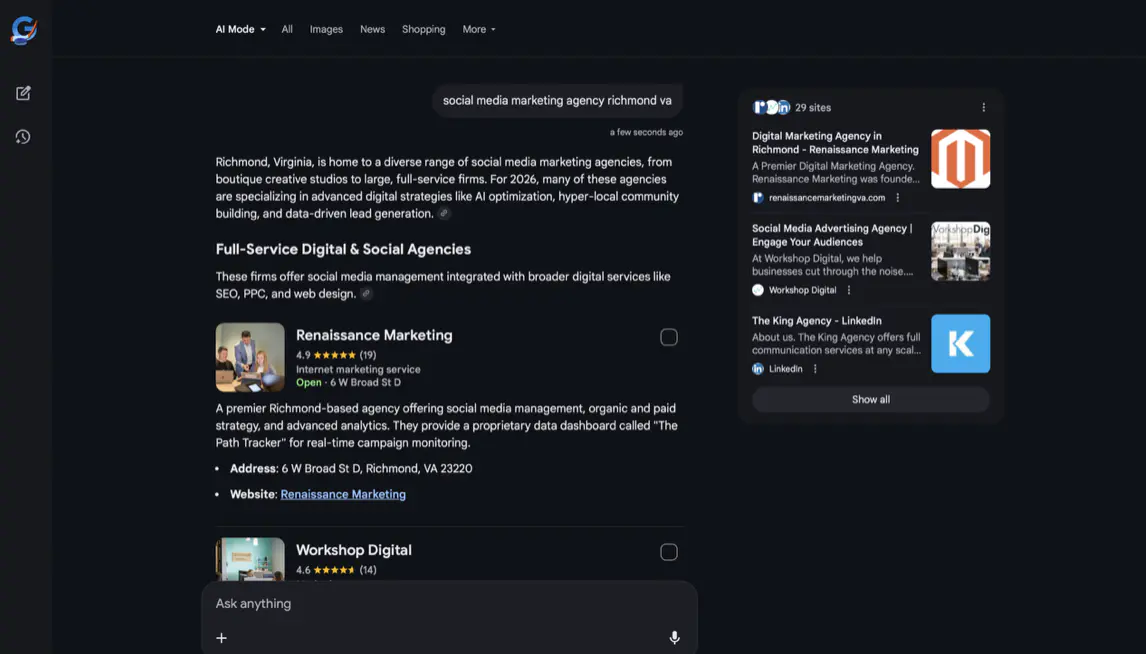
Richmond demonstrates something even more valuable: not just a single mention, but a full “AI-friendly business footprint” where Renaissance Marketing is surfaced with recognizable agency details.
What the screenshots show:
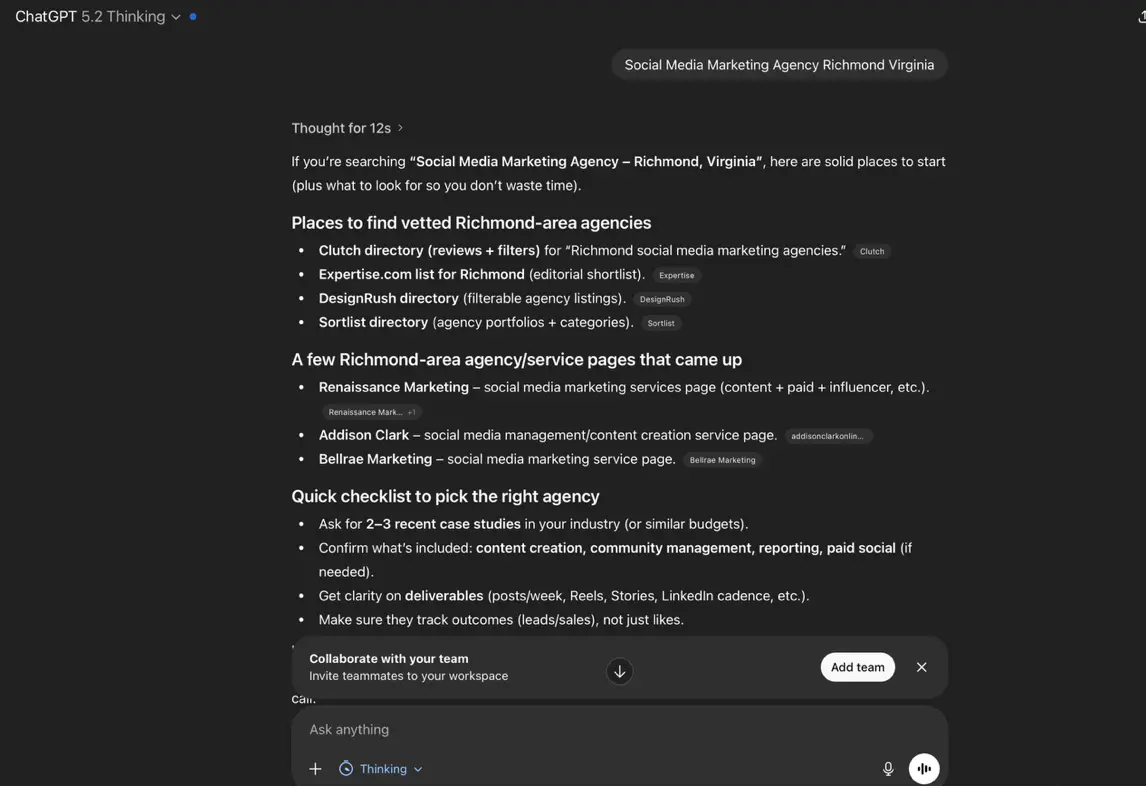
- In Google AI Mode for “social media marketing agency richmond va”, Renaissance Marketing appears as an agency option with surfaced business details (like location and website).
- In ChatGPT for Richmond agency discovery, Renaissance Marketing appears again as a relevant option, reinforced by cited sources.
This is the compounding effect you want: if multiple systems can independently surface you, the brand becomes “sticky” in the buyer’s mind.
AI SEO Visibility Results
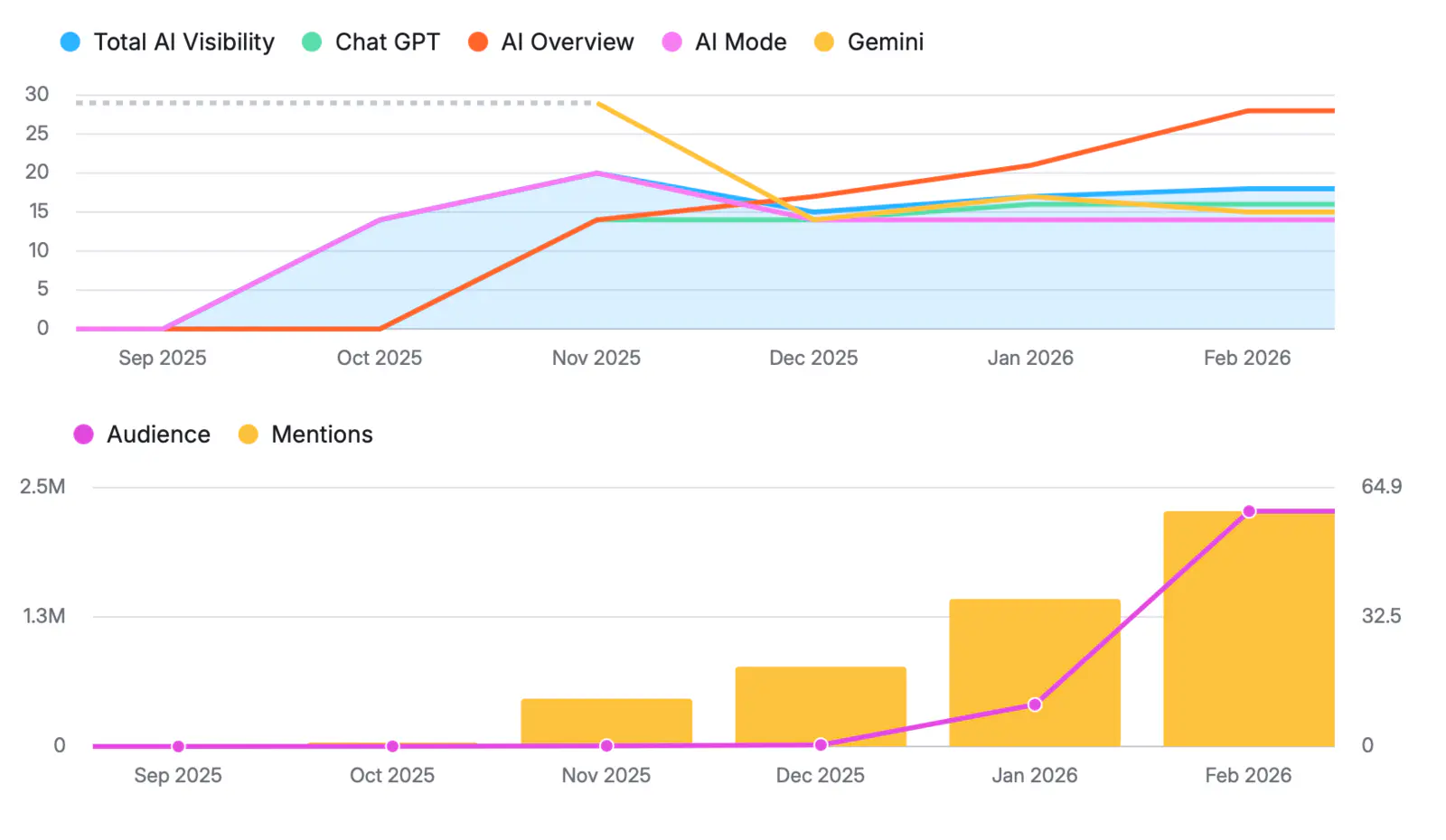
Screenshots are great because they show real appearances. But for an SEO case study, you also want trend data, something that shows visibility building over time rather than flashing for a week and disappearing.
That’s where Semrush AI Visibility comes in.
Semrush AI Visibility Metrics
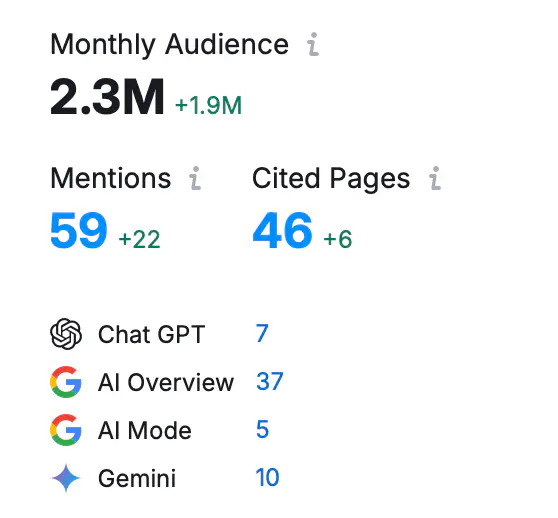
- Monthly Audience: 2.3M (+1.9M)
- Mentions: 59 (+22)
- Cited Pages: 46 (+6)
- Breakdown: ChatGPT (7), AI Overview (37), AI Mode (5), Gemini (10)
A quick translation:
- Mentions show how often the brand appears across tracked AI answers.
- Cited Pages show how many pages are being used as supporting evidence.
- Audience is a reach estimate—useful for understanding scale.
AI SEO Trendline evidence (Sep 2025 → Feb 2026)
The visibility trend (Sep 2025 through Feb 2026) shows growth that continues into February—exactly what you want to see when you’re building an entity-based presence rather than chasing one keyword.
What We Did – The Renaissance Marketing AI SEO Framework
This is where most case studies get too vague, so here’s the simple version: AI systems mention brands they understand, trust, and can summarize quickly.
We focused on making Renaissance Marketing easier to:
- recognize as a real entity
- associate with the right services
- associate with the right locations
- reference consistently
1) Entity + Local Authority Foundation
Before you chase “mentions,” you have to make sure the brand is easy to interpret. That means consistent signals about:
- Who you are (agency identity)
- What you do (services)
- Where you do it (Tampa + Richmond)
- Why you’re credible (proof points, experience, real-world validation)
2) Answer-First Content for AI Retrieval
AI experiences don’t browse the web like humans. They compress and summarize. So we structured content to match the way people ask and the way AI answers:
- short explanatory blocks
- clear service descriptions
- FAQ-style sections that AI can lift cleanly
3) Corroboration Layer = Trust Signals
Mentions are more likely when external and internal signals align. We emphasized credibility signals that support consistent referencing: a clear business footprint, supporting pages, and a brand presence that doesn’t contradict itself across platforms.
4) Measurement + Iteration
We treated AI visibility like a living channel. That means monitoring what surfaces are producing mentions, what pages are getting cited, and where opportunities exist to tighten messaging so the brand appears more often and more accurately. We use SEMRush’s AI Visibility tool along with Google Analytics to monitor our AI SEO performance.
Why This Worked – How AI Systems Decide Who to Mention
Most brands lose in AI because they’re “kind of” something. Kind of an agency. Kind of local. Kind of credible. AI doesn’t like “kind of.”
AI systems favor brands that are:
- Clear entities: easy to identify and categorize
- Easy to summarize: content is structured in digestible blocks
- Corroborated: multiple sources say the same thing about the brand
- Locally relevant: the brand is strongly tied to the market being searched
When those signals are strong, AI has less uncertainty, so it’s more willing to include the brand in a shortlist.
Key Takeaways for Local Businesses
AI SEO is a discovery multiplier
If you’re only optimizing for rankings, you’re playing yesterday’s traditional SEO game. AI SEO helps you show up where people are increasingly making decisions: inside summaries, shortlists, and AI-generated comparisons.
Visibility compounds across channels
When a buyer sees your brand recommended by AI and then sees your ad later, conversions tend to get easier. When they see you in an AI Overview and then find you again organically, trust builds faster. This is how AI visibility quietly boosts performance across SEO and PPC without needing a huge budget increase.
Our New Service — AI SEO with Renaissance Marketing
Because this approach is repeatable, we’ve packaged it as an add-on for clients who want to win in AI-driven discovery.
What’s included
- AI visibility audit (brand + competitors + query themes)
- Entity and local authority optimization
- AI-first content enhancements (FAQs, summaries, local proof)
- Ongoing reporting (mentions, cited pages, surface breakdown)
Who AI SEO is for
- Local service businesses trying to compete in crowded markets
- Multi-location brands that need consistent local presence
- Companies already investing in SEO/PPC that want incremental lift from AI discovery
Get Listed Across AI LLMs with Renaissance Marketing Today
If your customers are asking AI who to hire in your city, the goal is simple: be one of the names the AI confidently includes. Get started with your AI visibility today by adding our AI SEO service to your marketing mix!
AI SEO FAQs
What is AI SEO?
AI SEO is the process of improving a brand’s visibility in AI-generated results (Google AI Overview/AI Mode) and LLM answers (ChatGPT, Gemini, etc.) by strengthening entity signals, corroboration, and answer-friendly content.
How do you measure AI visibility?
AI visibility is commonly measured using metrics like mentions, cited pages, share-of-voice for target prompts, plus assisted conversions when tracking is available. Tools like Semrush AI Visibility can help quantify mentions and citations across AI surfaces.
Is AI SEO different from traditional SEO?
It builds on traditional SEO foundations but focuses more on entity clarity, extractable answers, and corroboration, signals AI systems rely on when generating recommendations.
How long does AI SEO take to work?
Timelines vary by competition and market, but many brands see early movement after improving entity and content foundations. Strong corroboration and ongoing iteration usually drive the compounding gains.
What’s the difference between Google AI Overview and Google AI Mode?
AI Overview typically appears within classic search results as a summarized answer. AI Mode is a more interactive AI-first results experience. Both can cite sources and surface recommended providers.
Which LLMs matter most for local service discovery?
For most local businesses, Google’s AI surfaces can be the biggest discovery driver. ChatGPT and Gemini can influence research and consideration depending on your audience and query type.