
- What AI Search Is (and Why It’s Not Just Google Anymore)
- Why Richmond Businesses Need to Move Now
- What AI Systems Actually Look For
- Optimize Your Google Business Profile
- Content Strategy for AI Search
- Technical SEO for AI Visibility
- Local Signals AI Platforms Trust
- Tracking Your AI Search Visibility
- Common Mistakes to Avoid
- Frequently Asked Questions
- How long does it take for a Richmond business to appear in AI search results?
- Does my business need to be on ChatGPT or Perplexity directly?
- Is traditional SEO still worth doing if AI search is growing?
- What is AEO and how is it different from SEO?
- Do Google reviews help with ChatGPT recommendations?
- Which Richmond industries benefit most from AI search optimization?
- The Window Is Open, But Not Forever
A homeowner in Short Pump opens ChatGPT and types: “Who is the best HVAC company near me?” More and more customers are researching companies this way.
AI search platforms no longer hand users ten links to sort through themselves. They generate a direct answer, sourced from businesses they’ve learned to trust. If yours isn’t one of them, you could be absent from the conversation entirely.
Richmond business owners need to act on this now. AI-assisted search queries have grown 182% year over year, and that growth is concentrated in exactly the industries where Richmond competition is fiercest: home services, healthcare, legal, hospitality, and financial services.
This guide covers the foundational signals, tactical steps, and tracking tools that Richmond business owners and marketing decision-makers need to build visibility in AI search.
What AI Search Is (and Why It’s Not Just Google Anymore)
AI search platforms synthesize information from across the web to generate a direct answer rather than a list of links. Where Google in 2019 gave you ten results, AI search gives you one answer and names the businesses behind the aggregated information.
Richmond customers are already using these platforms: Google AI Overviews, ChatGPT, Perplexity, Gemini, and Bing Copilot. Each works differently, but all share the same logic: They trust sources they’ve already learned to rely on and generate answers without the user ever visiting a search results page.
This is the core principle behind answer engine optimization, and it requires a different approach than traditional SEO.
Ranking vs. Being Cited
Ranking means your page appears on a search results page. Being cited means an AI system names your business in a generated answer. These overlap but aren’t the same. A business can sit on page one of Google and still be completely invisible to ChatGPT. Most Richmond businesses haven’t made that distinction yet.
Platform Snapshot
| Platform | How It Surfaces Local Businesses |
| Google AI Overviews | Pulls from Google Business Profiles (GBP), structured data, and trusted web sources |
| ChatGPT | Trained on web data, including directories, reviews, and media |
| Perplexity | Cites live web sources, favors authoritative content |
| Gemini | Closely tied to Google’s knowledge graph and GBP |
| Bing Copilot | Indexes Bing’s web data, including local business info |
Why Richmond Businesses Need to Move Now
Around 80% of businesses have no tracking in place for AI mentions of their brand. Most assume AI search optimization is just better SEO. It isn’t. Businesses actively optimizing for AI visibility are reporting 35% or greater improvements in AI search citations, and the window that makes early gains possible won’t stay open indefinitely.
Richmond isn’t a slow-growth market anymore. Scott’s Addition, Short Pump, Carytown, The Fan, and Church Hill each carry distinct commercial identities and intense local competition. Every major local industry — home services, legal, healthcare, restaurants, real estate — generates high volumes of conversational, location-specific AI queries daily.
The visibility gap matters more in AI search than anywhere else. On page two of Google, you’re overlooked. In AI search, you simply don’t exist.
What AI Systems Actually Look For
E-E-A-T and Entity Signals
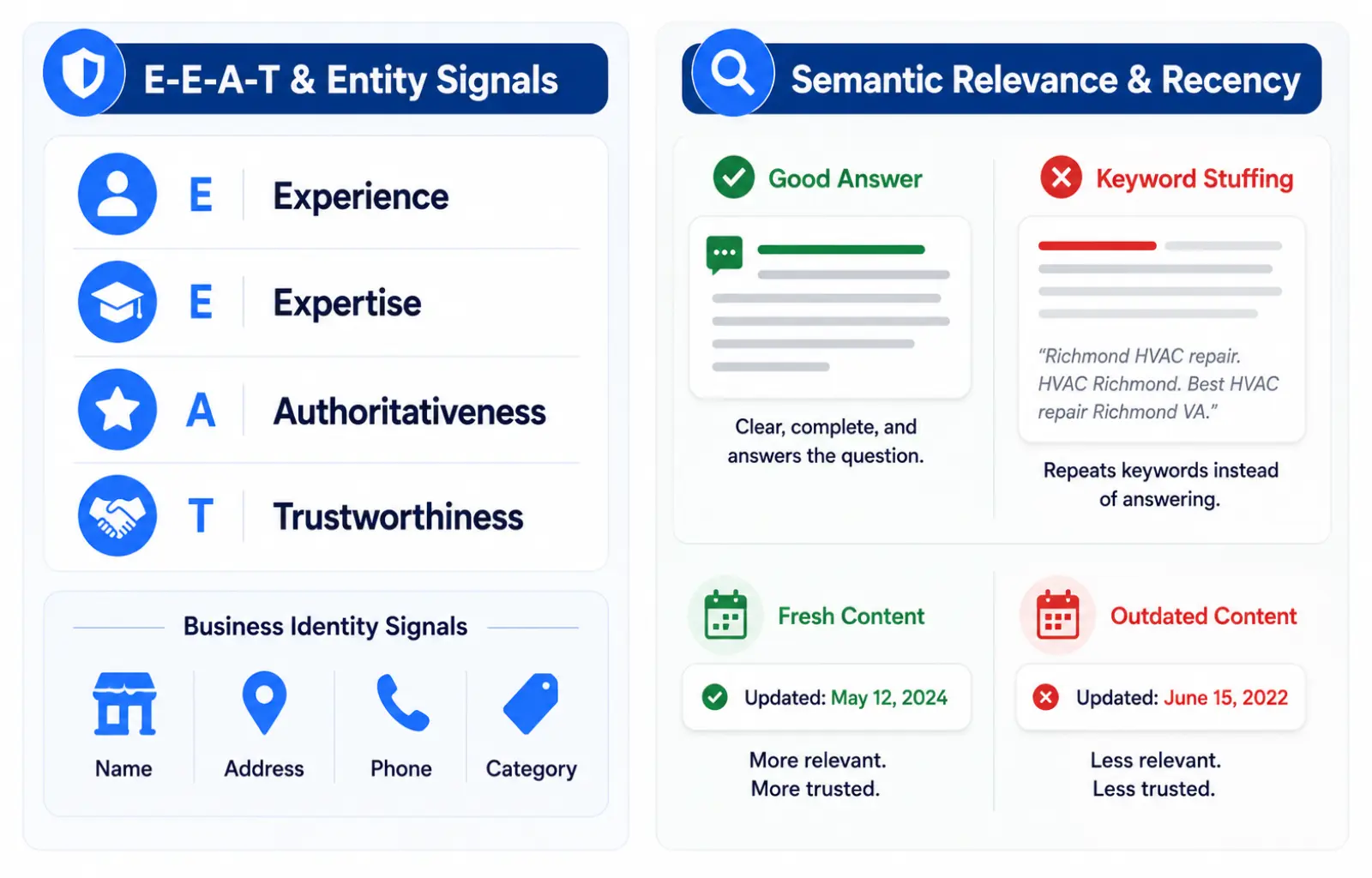
E-E-A-T (Experience, Expertise, Authoritativeness, and Trustworthiness) are the signals Google uses to evaluate content quality, and AI systems inherit them. A Mechanicsville roofing contractor who documents 18 years of completed projects demonstrates experience. A Richmond family law attorney who publishes clear answers to real client questions demonstrates expertise. A Midlothian dental practice cited in RVA Mag and the Richmond Times-Dispatch has built authority through external recognition.
AI systems also understand businesses as entities, not just websites. A consistent identity reflected in the same name, address, phone number, and category signals across the entire web. Inconsistent data creates entity confusion. Auditing your local business citations is one of the fastest ways to close that gap.
Semantic Relevance and Recency
AI systems read meaning, not just keywords. A page that thoroughly answers “what should I do if my HVAC stops working in summer” outperforms one that repeats “Richmond HVAC repair” dozens of times. Write the way a knowledgeable person explains something to a friend.
Recency matters, too. A page last updated two years ago carries less weight than one refreshed last quarter, even if the underlying information hasn’t changed. Build content freshness into your planning from the start.
Optimize Your Google Business Profile
Your Google Business Profile is the single highest-leverage action most Richmond businesses can take immediately. Google AI Overviews pull directly from GBP data, and an incomplete profile is one of the fastest paths to AI invisibility.
- Business category: Choose the most specific option available. A plumbing company shouldn’t default to “Contractor.”
- Service areas: List every neighborhood you serve, e.g., Carytown, The Fan, Church Hill, Scott’s Addition, Henrico, Chesterfield, Midlothian, Short Pump, Mechanicsville, Glen Allen.
- Business description: 250 words of natural language covering what you do, who you serve, and why you’re credible. No keyword stuffing.
- Q&A section: Seed it with the five questions customers ask most. Answer each directly and completely.
- Google Posts: At minimum two per month. Posts signal active business status, which feeds both GBP rankings and AI recency signals.
- Photos: Businesses with 100 or more photos earn significantly more views. Add completed work, staff, and location shots.
Review volume, recency, and the natural language customers use in review text all feed AI citation decisions. Building a consistent review system is where most businesses should start; aim for a minimum of 50 reviews at a 4.5-star average before expecting meaningful AI search presence. Respond to every review within 48 hours. Response rate is both a GBP ranking signal and an AI trust signal.
Content Strategy for AI Search
Answer-First Structure
AI systems extract answers from content that leads with the direct answer, not content that buries it in paragraph three. The structure is simple: direct answer first, supporting context second, additional detail third.
Before: “When it comes to HVAC maintenance in Richmond, there are a number of things homeowners should keep in mind depending on the season…”
After: “Richmond homeowners should schedule HVAC maintenance twice a year — in spring before cooling season and in fall before heating season.”
The second version is what AI systems cite.
FAQ Architecture
FAQ sections are among the most underused content formats for Richmond businesses and among the most powerful for AI citation. Each FAQ should be phrased the way a customer would actually speak or type the question, followed by a direct two-to-four sentence answer. For finding real questions, turn to Google’s “People also ask,” AlsoAsked.com, AnswerThePublic, and your own customer calls.
Neighborhood-Specific Content
A single “we serve Richmond” page isn’t sufficient for AI search. A Richmond HVAC company needs dedicated pages for Short Pump, Midlothian, Henrico, and Chesterfield, each with unique content, local references, and localized FAQs. AI systems match the geographic specificity of the query, and a generic service area page rarely earns those citations.
Topic Clusters
A pillar page supported by a network of related articles signals deep topical expertise to both Google and AI systems. An HVAC pillar page on “HVAC Services in Richmond VA” backed by cluster pages on seasonal maintenance, emergency repair, energy efficiency, and neighborhood-specific service pages is a clear example of how that architecture works in practice.
For industry-specific content strategies, see Renaissance Marketing’s guides for HVAC, dental and healthcare, and other Richmond verticals.
Technical SEO for AI Visibility
Schema Markup
Schema markup is structured code that tells AI systems exactly what your content is about. The types most relevant to Richmond businesses:
- LocalBusiness schema: name, address, phone, hours, and service area in machine-readable format
- FAQ schema: allows AI systems to extract answers directly from your FAQ content
- Service schema: identifies the specific services you offer
- Review schema: surfaces your aggregate rating in search results
Core Web Vitals and Mobile
Core Web Vitals directly influence rankings and, by extension, AI citation. Your targets should be: LCP under 2.5 seconds, CLS under 0.1, INP under 200 milliseconds. Run a free self-audit at Google PageSpeed Insights.
Over 70% of local Richmond searches happen on mobile, and AI Overviews are predominantly surfaced there. Make sure your site has a minimum 16px font size, tap targets at least 44x44px, no horizontal scrolling, click-to-call phone numbers, and load times under 3 seconds on a 4G connection.
Local Signals AI Platforms Trust
NAP Consistency and Citations
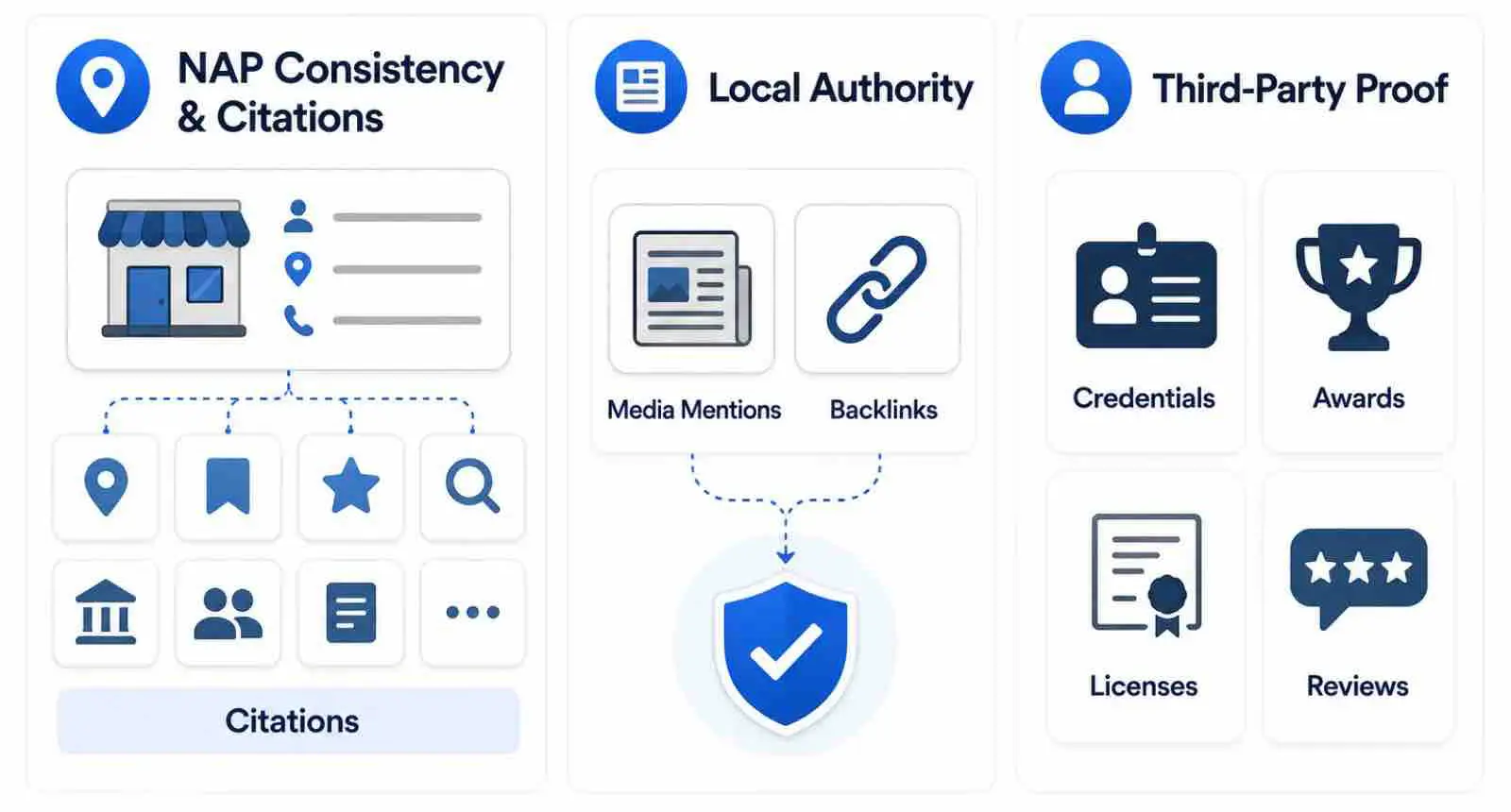
NAP (Name, Address, Phone) must be consistent across every platform where your business appears. Inconsistencies create entity confusion and weaken citation potential. Audit by searching your business name in Google and checking every listing that appears. Prioritize Google Business Profile, Yelp, Bing Places, Apple Maps, the Richmond Chamber of Commerce, the Greater Richmond Regional Chamber, Angi, and industry-specific directories.
Local Media and Backlinks
A mention in the Richmond Times-Dispatch, RVA Mag, Style Weekly, NBC12, or Axios Richmond carries real authority weight. These are sources AI platforms have already learned to trust, and when they cite your business, that signal propagates into AI-generated answers. Sponsor a community event, offer expert commentary to a local journalist, or pitch a bylined piece to a local publication.
Local backlinks follow the same logic. A link from the Greater Richmond Chamber of Commerce or VCU is worth more for Richmond AI visibility than any national directory link.
Author and Third-Party Signals
AI systems increasingly favor content with an identifiable human expert behind it. Add author bio pages for anyone contributing content to your site, with credentials, Richmond experience, and a headshot. Display BBB accreditation, awards, state licenses, and industry certifications visibly on your website and in your GBP description. These serve as third-party proof of credibility that AI systems recognize.
Tracking Your AI Search Visibility
Manual Audit
Test your business today. Open ChatGPT, Perplexity, Gemini, and Google and ask questions your customers might ask, like:
- “Best [your service] in [your neighborhood] Richmond VA”
- “Who are the most trusted [your industry] companies in Richmond?”
- “What [your service] company should I call in [your area]?”
Note which businesses are named. If yours isn’t among them, you have a baseline.
Tools and Metrics
| Tool | What It Tracks | Cost |
| SE Ranking AI Overview Tracker | Google AI Overview appearances | Paid |
| Semrush AI Toolkit | AI-generated result tracking | Paid |
| BrightLocal | Citation consistency, GBP performance | Paid (free trial) |
| Google Search Console | Impressions, clicks, indexation | Free |
| Google PageSpeed Insights | Core Web Vitals scoring | Free |
| AlsoAsked.com | FAQ content research | Freemium |
The metrics that matter most: AI Overview appearances, GBP impressions and actions, branded search volume, direct traffic, and review velocity. Set realistic expectations; GBP changes take 2–4 weeks to index, schema effects appear in 4–8 weeks, and content-driven AI citation improvements typically take 8–16 weeks. Authority building compounds over 3–6 months.
Common Mistakes to Avoid
- Treating AI search as separate from traditional SEO. Strong traditional SEO is the foundation AI systems build on.
- Neglecting GBP while investing in website content. For local businesses, GBP can even be a higher-leverage AI signal than the website itself.
- Writing keyword-stuffed content instead of intent-matched answers. AI systems surface content written for customers, not crawlers.
- Relying on a single Richmond service page. A customer in Midlothian gets Midlothian-specific answers. Generic pages rarely earn those citations.
- Ignoring review velocity. A profile with 150 reviews and nothing new in six months signals a decline to AI systems.
- Abandoning the strategy too early. AI search authority compounds. Six months of consistency outperform any short sprint.
Frequently Asked Questions
How long does it take for a Richmond business to appear in AI search results?
Most businesses see incremental improvements in AI Overview appearances within 4–8 weeks of implementing GBP optimization and schema markup. Full citation presence in platforms like ChatGPT and Perplexity typically takes 3–6 months of consistent effort.
Does my business need to be on ChatGPT or Perplexity directly?
No. These platforms don’t have business listing systems. They pull from publicly available sources like your website, GBP, local directories, and media coverage. Optimizing those sources is how you influence what AI systems say about you.
Is traditional SEO still worth doing if AI search is growing?
Yes. AI systems rely on the same foundational signals as traditional SEO: quality content, authoritative backlinks, technical health, and consistent business information. The two reinforce each other.
What is AEO and how is it different from SEO?
AEO stands for Answer Engine Optimization. Where SEO focuses on ranking in a list of links, AEO focuses on being the direct answer an AI system generates. It requires an answer-first content structure, FAQ architecture, and schema markup that traditional SEO doesn’t always prioritize. This breakdown of generative engine optimization covers the distinction in full.
Do Google reviews help with ChatGPT recommendations?
Indirectly, yes. ChatGPT was trained on web data that includes review aggregators, local directories, and media coverage referencing review ratings. A strong review profile across multiple platforms increases the likelihood of positive AI associations.
Which Richmond industries benefit most from AI search optimization?
Any business that depends on local customer discovery benefits. Home services, legal, healthcare, restaurants, and real estate see the highest concentration of AI-influenced local queries in the Richmond market.
The Window Is Open, But Not Forever
AI search is raising the bar for what a credible local presence looks like, not replacing the fundamentals that have always mattered. Businesses that have invested in quality content, consistent local signals, and genuine authority are already better positioned than those that haven’t. The work required to show up in AI-generated answers is the same work that makes a business credible across every channel.
Richmond’s market is competitive enough that early movers will hold a meaningful advantage. The businesses that start now with disciplined GBP management, structured content, technical fundamentals, and local authority will be the ones cited consistently six months from now while competitors are still catching up.
If you’re ready to see exactly where you stand, Renaissance Marketing offers a free AI and SEO audit for Richmond businesses. Start the conversation here.
For a closer look at what this work produces in practice, check out our AI SEO case study for Tampa and Richmond.