
- What Is the Google Map Pack and Why Does It Matter?
- How Google Decides Who Gets in the Map Pack
- The 7-Step Google Map Pack Optimization Guide
- Step 1: Claim and Verify Your Google Business Profile
- Step 2: Fully Optimize Your Google Business Profile
- Step 3: Build NAP Consistency and Local Citations
- Step 4: Generate and Manage Google Reviews
- Step 5: Optimize Your Website for Local SEO Signals
- Step 6: Build Local Backlinks to Increase Prominence
- Step 7: Track Your Map Pack Performance and Iterate
- Common Mistakes That Keep Businesses Out of the Map Pack
- FAQ About the Google Map Pack
- Start Showing Up in the Google Map Pack Today
Someone in Richmond, VA searches “best plumber near me” on their phone. The first three results they see on Google aren’t websites. They’re the Map Pack.
For local businesses, few spots on the internet are more valuable than the Google Map Pack. If you’re wondering how to show up in the Google Map Pack, we can walk you through exactly what it takes, from the basics of how it works to the specific steps you can take to improve your chances of landing there.
What Is the Google Map Pack and Why Does It Matter?
What Is the Google Map Pack (Local 3-Pack)?
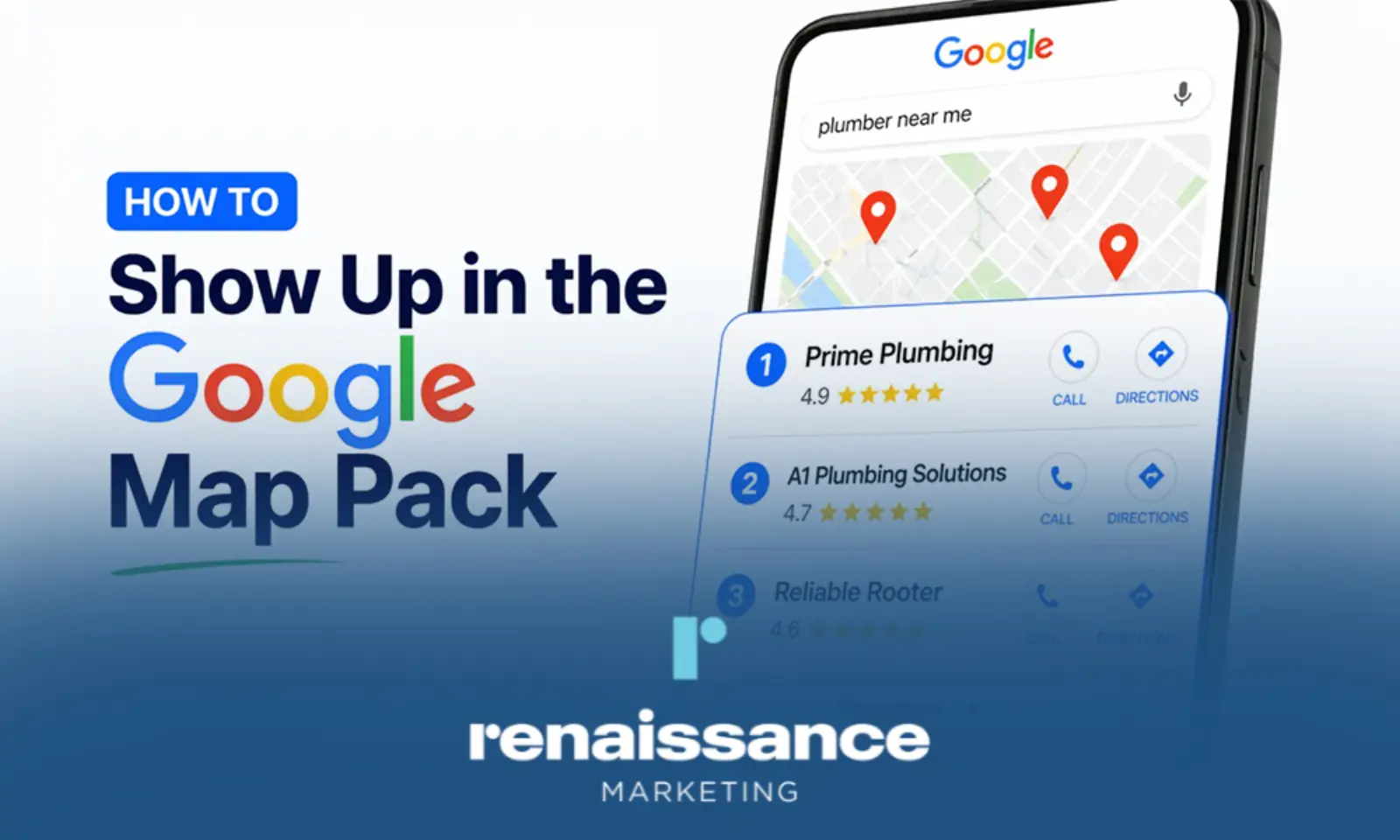
The Google Map Pack, also called the Local 3-Pack, is the block of three business listings that appears at the top of Google’s results when someone searches for a local service or product. It includes a map, business names, ratings, hours, and links to call or get directions.
When someone searches “dentist near me” or “movers in Jacksonville FL,” the Map Pack is typically the first thing they see.
The 3 Businesses Everyone Sees First
Only three businesses appear in the standard Map Pack. Occasionally, Google will show a “More places” option that expands the list, but the top three receive the vast majority of clicks. For most users, these are the only options they consider before making a call, visiting a website, or stopping by in-person.
Why It’s Important
Studies consistently show that Map Pack listings attract a significant share of clicks on local search results pages. Appearing here puts your business in front of high-intent searchers at the exact moment they’re ready to act. It also drives visibility on Google Maps itself, which many users navigate directly.
For businesses that rely on local customers, Map Pack placement can be the difference between a full calendar and an empty one.
How Google Decides Who Gets in the Map Pack
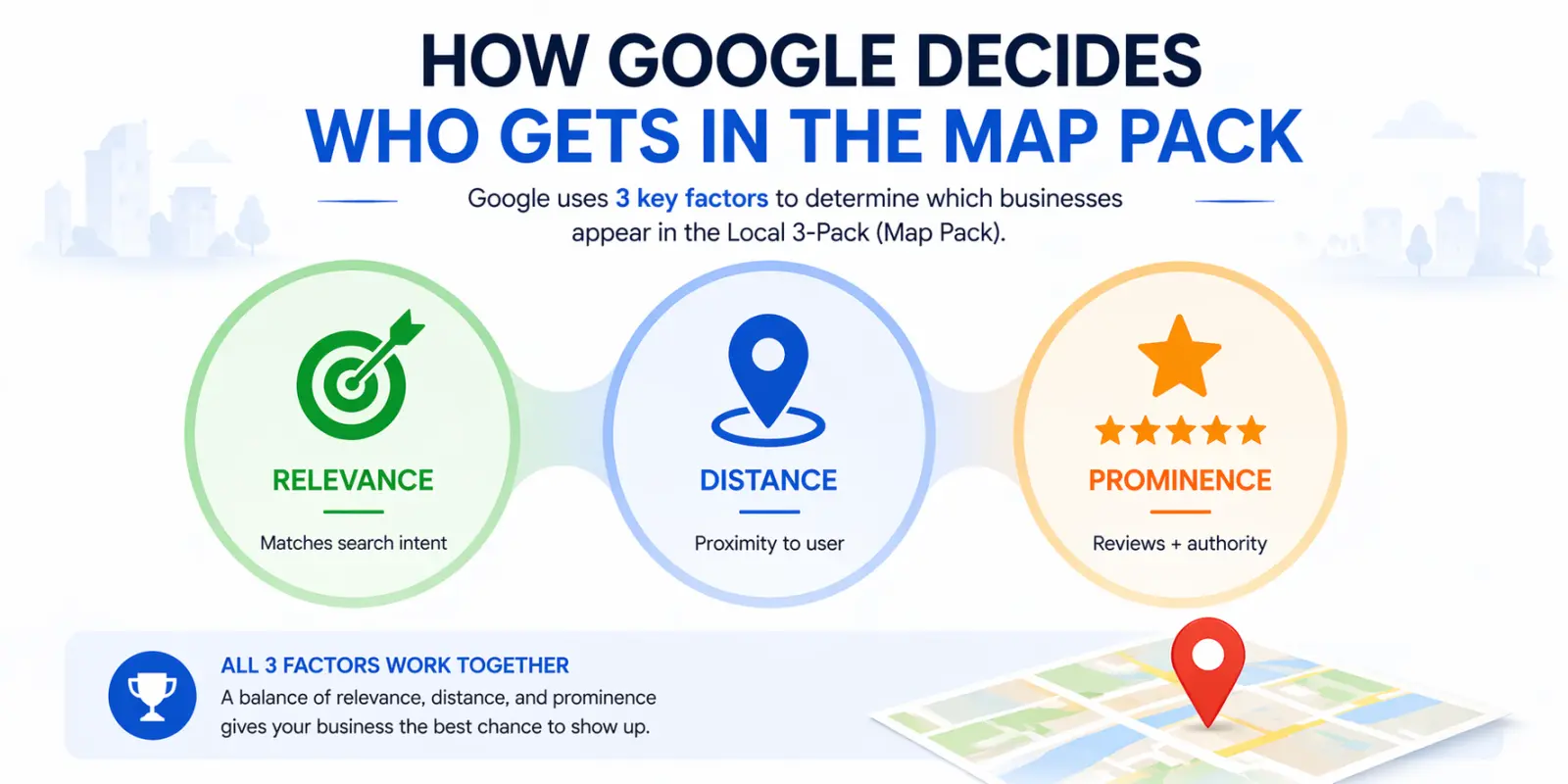
Google evaluates local businesses using three core factors. Understanding these is foundational to improving your Google Map Pack ranking.
Relevance
Relevance measures how well your business matches what the searcher is looking for. A plumbing company with a well-optimized profile that clearly describes its services is more likely to appear for plumbing searches than one with a vague or incomplete listing.
Distance
Google factors in how far your business is from the searcher or from the location mentioned in their query. Proximity matters, but it doesn’t override relevance or prominence. A business that’s slightly farther away but significantly more prominent may still outrank a closer competitor.
Prominence
Prominence reflects how well-known and trusted your business is, both online and offline. Google evaluates factors like the number and quality of reviews, links to your website from other sites, mentions across the web, and how complete and active your Google Business Profile is.
Why All Three Factors Matter
No single factor guarantees Map Pack placement. A business might be highly relevant and close to the searcher but still lose out to a competitor with far more reviews and web authority. Sustainable local visibility requires attention to all three dimensions together.
The 7-Step Google Map Pack Optimization Guide
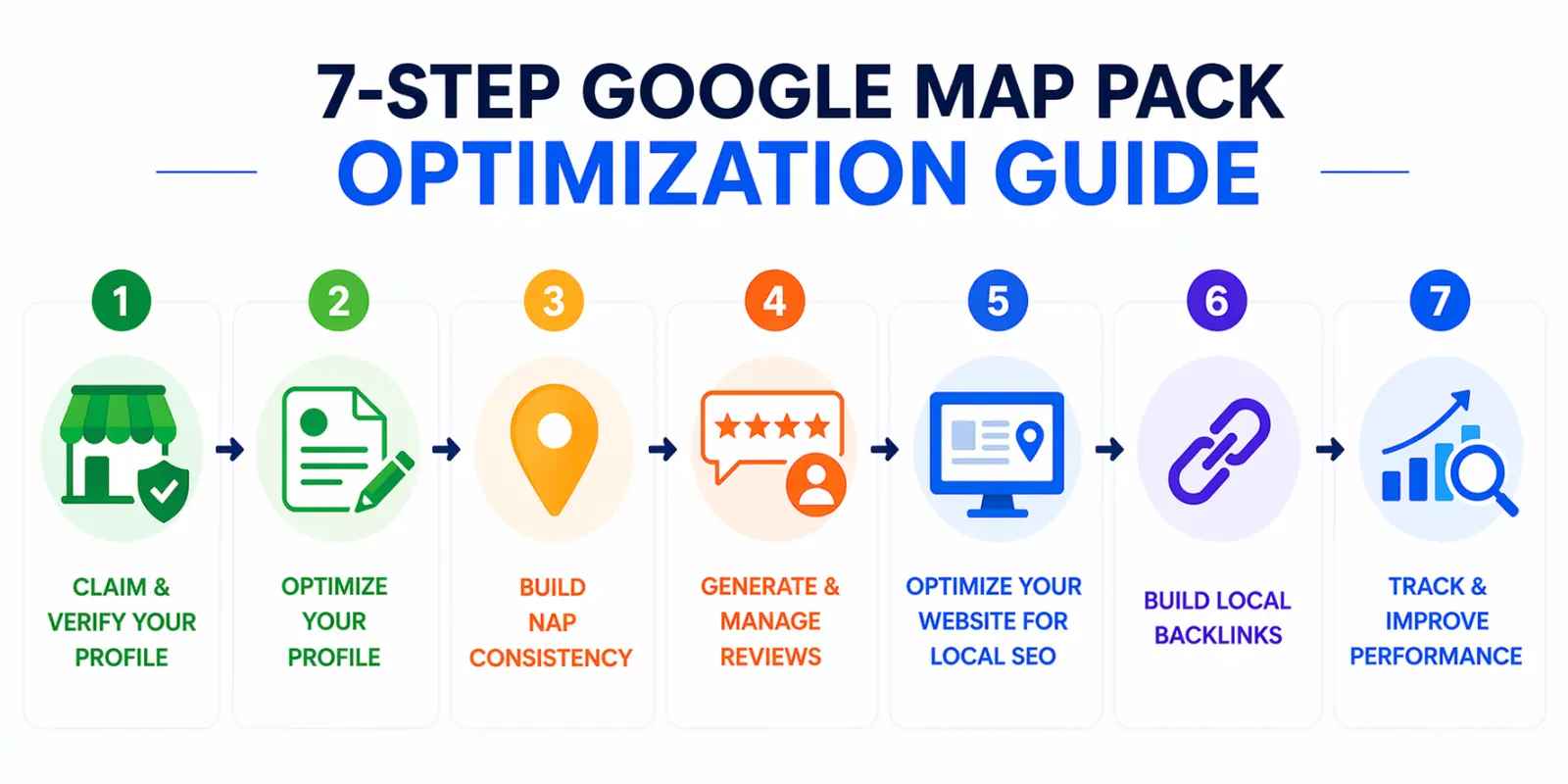
Step 1: Claim and Verify Your Google Business Profile
If you haven’t already claimed your Google Business Profile, that’s the first step. Go to Google Business Profile, search for your business, and follow the verification process. Google typically verifies via postcard, phone, or video call.
Without a verified profile, your business won’t appear in the Map Pack at all.
Step 2: Fully Optimize Your Google Business Profile
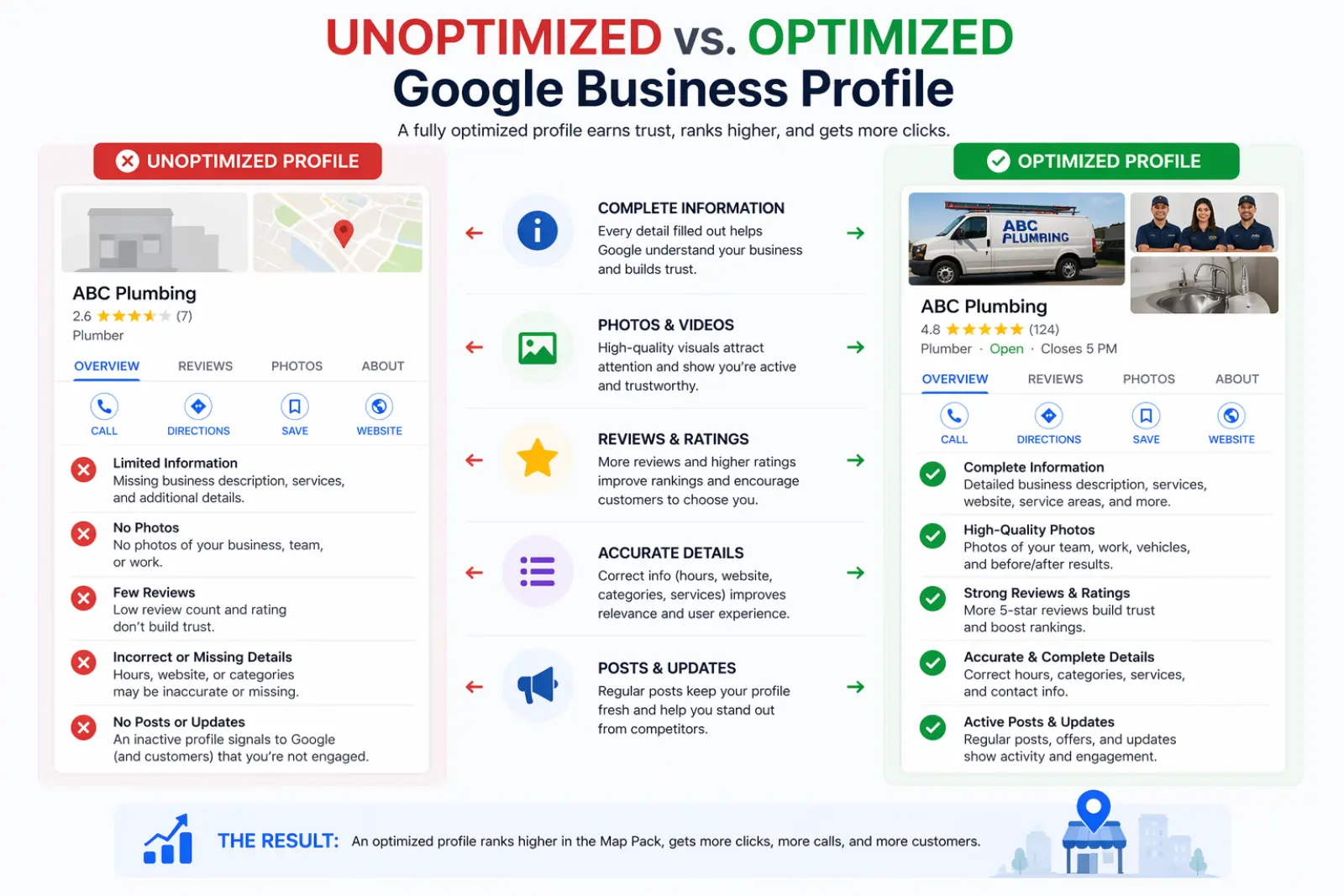
Once verified, treat your profile as a living asset. Fill out every available field: business name, address, phone number, website, hours of operation, service areas, and a detailed business description. Upload high-quality photos of your location, team, and work. Select the most accurate primary and secondary categories.
Completeness signals credibility to Google and gives potential customers the information they need to choose you.
Step 3: Build NAP Consistency and Local Citations
NAP stands for Name, Address, and Phone Number. These three data points need to appear identically across every directory and platform where your business is listed: Yelp, Apple Maps, the Better Business Bureau, industry directories, and anywhere else.
Inconsistent listings confuse both Google and searchers. Audit your citations regularly and correct any discrepancies.
Step 4: Generate and Manage Google Reviews
Reviews are one of the strongest signals Google uses for Map Pack ranking. Businesses with more reviews and higher average ratings consistently outperform those without. More importantly, reviews build trust with the people who see them.
Ask satisfied customers to leave a review directly on your Google profile. Make it easy by sending a direct link. Respond to every review, positive and negative, in a professional and timely manner.
Step 5: Optimize Your Website for Local SEO Signals
Your website reinforces your Map Pack presence. Make sure your site includes your city and service areas in page titles, meta descriptions, and body content. Create location-specific pages if you serve multiple markets. Embed a Google Map on your contact page.
Structured data markup, specifically LocalBusiness schema, helps Google understand your business details and connect them to your profile.
Step 6: Build Local Backlinks to Increase Prominence
Links from locally relevant websites, local news outlets, chambers of commerce, and industry associations strengthen your prominence in Google’s eyes. Sponsoring community events, partnering with complementary local businesses, and earning press mentions are all effective ways to build this kind of authority over time.
Prominence is harder to build quickly than profile completeness, but it tends to have a lasting impact on your ranking.
Step 7: Track Your Map Pack Performance and Iterate
Use Google Business Profile Insights to monitor how often your profile appears in search, how many clicks it receives, and what actions users take. Tools like BrightLocal or Google Search Console can offer additional visibility into your local rankings.
Local SEO is not a one-time task. Review performance data regularly, test new content, and continue gathering reviews. Consistency over time is what separates businesses that hold Map Pack positions from those that fall in and out.
Common Mistakes That Keep Businesses Out of the Map Pack
Keyword Stuffing Your Business Name
Adding keywords to your business name in your Google Business Profile (for example, “Smith Plumbing Best Plumber Richmond VA”) violates Google’s guidelines and can result in suspension. Use your actual, legal business name.
Incomplete or Inconsistent NAP
Missing a suite number in one directory or using a slightly different phone number on another site creates confusion. Google rewards consistency and penalizes ambiguity.
Ignoring Negative Reviews
A pattern of unanswered one-star reviews signals poor customer experience. Responding professionally, even when the feedback is unfair, shows both Google and future customers that your business is attentive and accountable.
Choosing the Wrong Primary Category
Your primary category is one of the most influential fields in your Google Business Profile. If you run a dental practice and select “Medical Clinic” as your primary category instead of “Dentist,” you’re working against yourself in local search.
Not Posting on Google Business Profile
Google allows businesses to post updates, offers, events, and service announcements directly to their profile. Regular posting signals an active, engaged business. Profiles that go months without activity can lose ground to competitors who post consistently.
FAQ About the Google Map Pack
How Long Does It Take to Show Up in the Map Pack?
It varies. For new businesses in less competitive markets, visibility can appear within a few weeks of verification and optimization. In competitive industries or densely populated areas, building enough prominence to rank can take several months of consistent effort.
Can Service Area Businesses Rank in the Map Pack?
Yes. Businesses that serve customers at their location, like plumbers or cleaning services, can rank in the Map Pack even without a storefront. In Google Business Profile, you can designate service areas instead of displaying a physical address.
Do You Need a Physical Address to Rank in the Map Pack?
Not necessarily. Service area businesses can hide their address in Google Business Profile while still ranking locally. That said, businesses with a verified physical location typically have an advantage in proximity-based ranking.
How Many Google Reviews Do You Need?
There’s no magic number. What matters more than volume alone is recency and consistency. A business with 40 recent reviews spread across the past year will often outperform one with 100 reviews that are three years old. Aim to generate new reviews on an ongoing basis.
Is the Google Map Pack the Same as Organic Results?
No. The Map Pack is a distinct feature powered by Google Business Profile and local search algorithms. Organic results appear below the Map Pack and are driven primarily by traditional website SEO. A business can rank well in one without appearing in the other, though strong local SEO efforts tend to support both.
Start Showing Up in the Google Map Pack Today
Figuring out how to get on Google Maps’ first page is a process that rewards consistency, completeness, and genuine customer engagement. There’s no shortcut to a sustained Map Pack presence, but the path is clear for businesses willing to invest in the fundamentals.
If you’re ready to improve your local search visibility and attract more customers from Google, Renaissance Marketing helps regional and multi-location businesses build the kind of local SEO foundation that turns search results into real growth.