
- What Is AI Search, and How Is It Different From Google’s “10 Blue Links?”
- The Citation Economy: How AI Systems Choose Which Businesses to Mention
- The AI SEO Framework: 5 Pillars That Get You in AI Answers
- Content Strategy That Wins AI Search
- How to Track Rankings in AI Searches
- Avoid Spammy AI Content
- FAQ on AI Search Optimization
- Can my business “rank” in ChatGPT search results?
- How do I get my website to appear in ChatGPT searches?
- How do I get cited in Google AI Overviews?
- Is Google SGE the same thing as AI Overviews?
- Does classic SEO still matter in AI search?
- How long does AI SEO take to work?
- What industries benefit most from GEO?
- What should I do if AI answers mention competitors instead of me?
- Show up in AI Searches with Renaissance Marketing
Search has changed. Users are increasingly getting answers without clicking a single link using Google’s AI Overviews, ChatGPT, and other generative AI tools that summarize information and cite sources on their own terms. If your business isn’t showing up in those answers, you’re losing visibility to competitors who are.
Understanding how to rank in AI search isn’t a niche concern anymore. It’s a core part of staying competitive. This guide breaks down what AI search is, why it behaves differently from traditional SEO, and exactly what you can do to start appearing in AI-generated answers.
What Is AI Search, and How Is It Different From Google’s “10 Blue Links?”
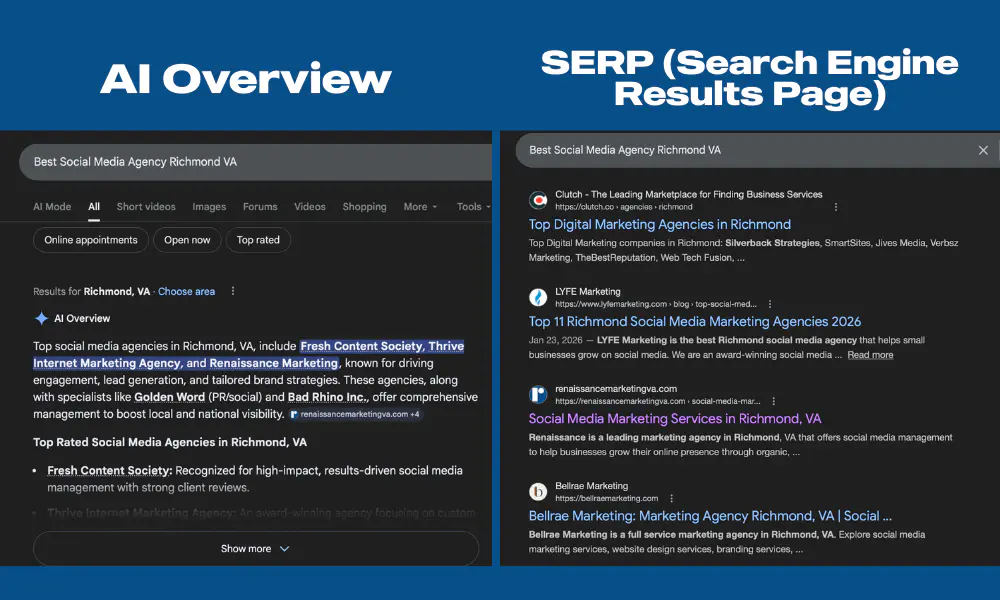
Traditional search returns a ranked list of links. The user clicks, reads, and decides. AI search skips the list entirely; it synthesizes information from multiple sources and delivers a direct answer, often with citations embedded in the response.
Google’s AI Overviews pull content from indexed web pages and stitch together summaries. ChatGPT, Bing Copilot, Perplexity, and others do something similar, scanning the web for relevant, credible content and attributing specific sources.
The key difference: These systems are choosing what to say and who to credit. That decision is based on content quality, site authority, and how well your pages match the way a query was structured—not just keyword density or backlink count.
The Citation Economy: How AI Systems Choose Which Businesses to Mention
Eligibility Comes First
Before an AI model can cite your business, it has to be able to access your content. That means your site must be crawlable, indexed, and not blocking the bots that AI tools rely on. Many businesses unknowingly prevent these systems from reading their pages through overly restrictive robots.txt files or aggressive bot-blocking settings.
Why Structure Beats Fluff
AI systems reward pages that are well-organized, factually precise, and scannable. Long-winded introductions, vague claims, and keyword-stuffed paragraphs don’t get cited. They get ignored. Content written with a clear question-and-answer structure, supported by data and specifics, is far more likely to be pulled into a generated response.
Query Fan-Out
Generative AI doesn’t process a single query in isolation. It expands the original question into related sub-questions (a process called query fan-out) and retrieves content that addresses multiple angles of a topic. Businesses with deep, well-structured content across a topic area have a significant advantage over those with thin, standalone pages.
The AI SEO Framework: 5 Pillars That Get You in AI Answers
1. Make Your Content Easy to Fetch with Technical SEO
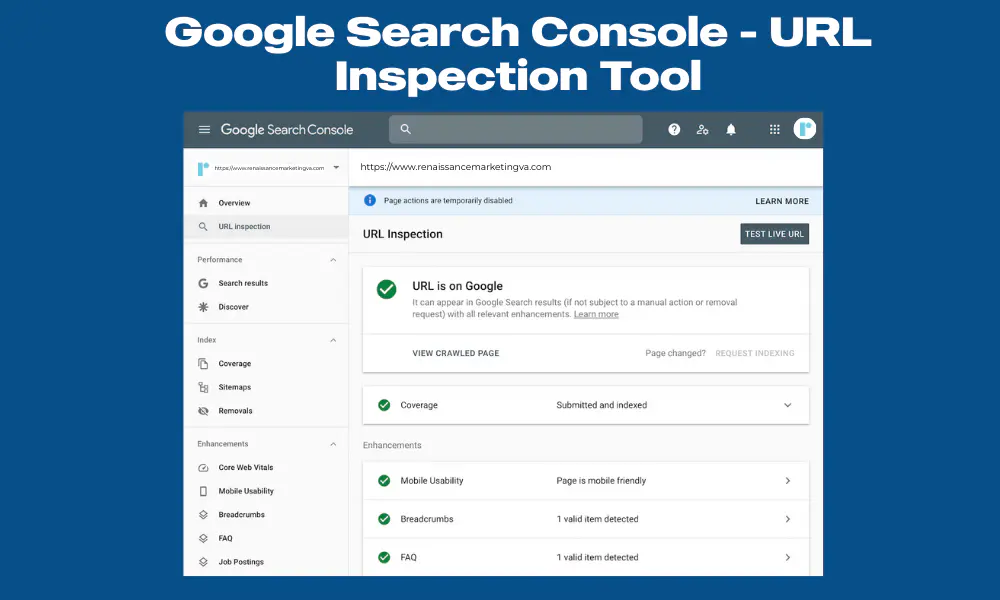
AI models can’t cite what they can’t reach. Technical SEO is the foundation:
- Ensure your sitemap is current and submitted to Google Search Console
- Review your robots.txt file and confirm you’re not blocking Googlebot, GPTBot, PerplexityBot, or other relevant crawlers
- Fix broken links, slow load times, and crawl errors
- Use HTTPS and ensure mobile usability
If an AI model can’t access your page reliably, no amount of great content will help.
2. Create “Entity” to Teach the Machine Who You Are
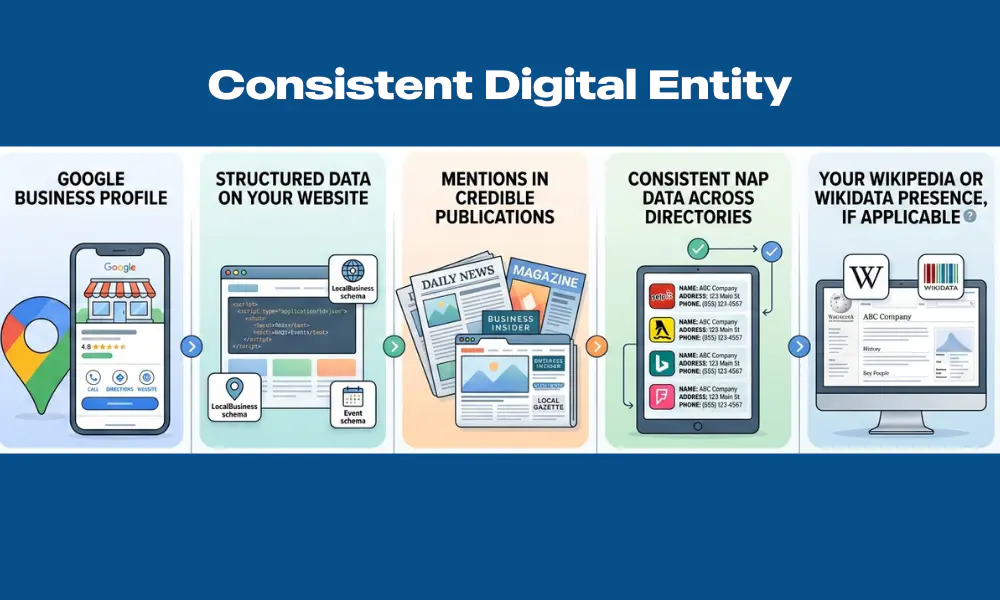
Entity SEO means building a consistent, recognizable digital identity across the web. AI systems build their understanding of a business from many signals: your Google Business Profile, structured data on your website, mentions in credible publications, consistent NAP (name, address, phone) data across directories, and your Wikipedia or Wikidata presence, if applicable.
The clearer and more consistent your entity signals, the more confidently an AI model can attribute information to your business.
3. Write Answer-First Content That’s Easy to Quote
Lead every piece of content with the direct answer to the question being asked. Don’t bury the key insight three paragraphs in. AI systems prioritize content that gets to the point quickly and uses clear, quotable language.
Effective AI-ready content:
- Answers the primary question within the first two to three sentences
- Uses natural language that mirrors how people actually ask questions
- Breaks complex information into short, digestible sections
- Includes specific examples, statistics, or data points that add credibility
4. Align Structured Data & Content
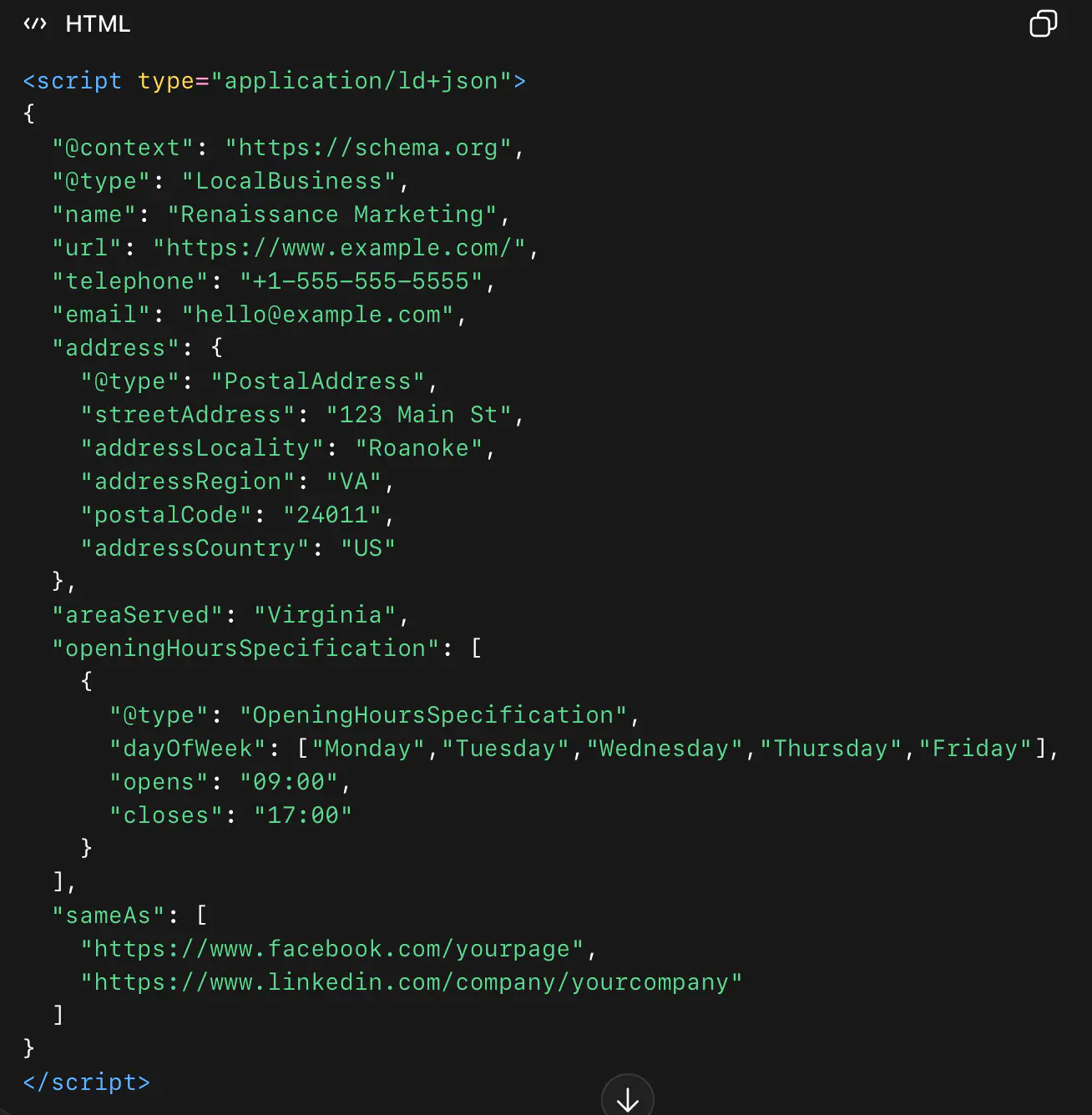
Schema markup—JSON-LD structured data added to your site’s code—signals to both traditional search engines and AI systems exactly what your content is about. For local businesses, this includes LocalBusiness schema. For FAQs, use FAQPage schema. For services, Service schema is appropriate.
Structured data and your on-page content must be consistent. If your schema says you’re a dental practice in Richmond but your page copy doesn’t support that, the signal is weak. Alignment between markup and content amplifies both.
5. Build Online Authority
AI models weight credibility heavily. Authoritative backlinks from relevant publications, industry directories, and local news sources signal that your business is a trustworthy source. This doesn’t require hundreds of links; it requires the right ones.
Earning placements in local business roundups, contributing expert quotes to trade publications, and maintaining strong reviews on Google and other platforms all build the kind of authority that makes AI systems more likely to surface your name.
Content Strategy That Wins AI Search
Build Topic Ecosystems
Rather than publishing isolated blog posts, build interconnected content hubs around topics your audience is actively researching. A home services company, for example, might build a topic cluster around HVAC maintenance, with a pillar page covering the topic broadly and supporting articles addressing specific seasonal questions, cost estimates, and troubleshooting scenarios.
AI systems recognize depth. When your site thoroughly addresses a topic from multiple angles, you become a more reliable source to cite.
Use Strategic Internal Linking
Internal links tell AI crawlers how your content is organized and which pages carry authority. Every supporting article should link back to its pillar page. Related content should reference each other where it adds value to the reader. A well-linked site sends clear topical signals and increases the likelihood that any one of your pages gets pulled into an AI response.
How to Track Rankings in AI Searches
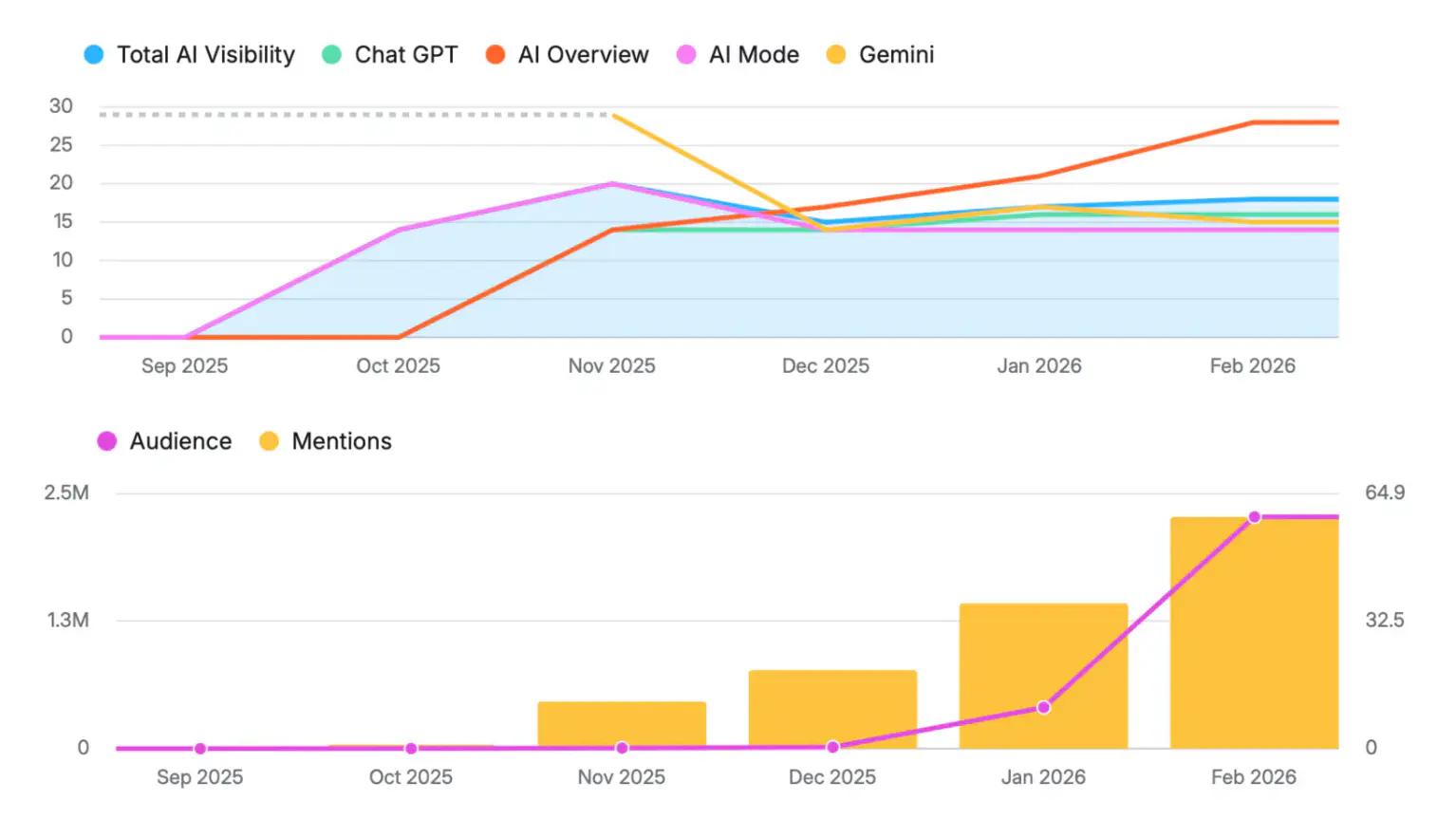
Measuring AI search visibility requires different tools than tracking traditional keyword rankings. A few approaches:
- Manually query ChatGPT, Perplexity, and Google AI Overviews as if you were a customer, and note whether your business is cited
- Use tools like Semrush’s AI Overviews tracker or Surfer AI to monitor GEO-specific visibility
- Set up Google Search Console to track impressions and clicks from AI Overview traffic (Google is expanding this reporting)
- Monitor brand mentions and unlinked citations using tools like Ahrefs Content Explorer or Brand24
Tracking AI search is still an evolving space. Consistent manual monitoring paired with available tool data is currently the most reliable approach.
Avoid Spammy AI Content
Some businesses are trying to game AI search by publishing thin, AI-generated articles stuffed with target phrases and little else. This approach backfires.
AI language models are increasingly sophisticated at identifying low-quality, formulaic content. They look for content written by humans, for humans. Flooding a site with generic AI-written posts doesn’t just fail to improve AI visibility—it can actively hurt your domain authority.
Effective generative engine optimization (GEO) depends on genuine expertise, original perspective, and content that’s actually useful to the reader. Use AI tools to assist your content process if it helps, but prioritize human editorial judgment and real subject matter expertise in every piece you publish.
FAQ on AI Search Optimization
Can my business “rank” in ChatGPT search results?
Not in the traditional sense. ChatGPT doesn’t produce a ranked list of links; it generates a synthesized response and may cite sources it draws from. Your goal is to be cited, not ranked. That happens when your content is accessible, credible, and directly relevant to the questions being asked.
How do I get my website to appear in ChatGPT searches?
Start with crawl access. Make sure you’re not blocking GPTBot or other AI crawlers in your robots.txt file (OpenAI’s crawlers need permission to index your content). From there, focus on publishing clear, factual, well-structured content that directly answers questions your audience is searching for. A strong backlink profile and consistent entity signals (via Google Business Profile, structured data, directory listings) increase the likelihood that ChatGPT surfaces your business when relevant queries come in.
How do I get cited in Google AI Overviews?
Google AI Overviews pull from pages that are already indexed and performing well in organic search. The best path to citation is strong traditional SEO combined with an answer-first content structure. Pages that already rank in the top results for a query are significantly more likely to be included in an AI Overview for that same query. FAQPage schema also helps signal to Google which parts of your content are designed to answer specific questions.
Is Google SGE the same thing as AI Overviews?
Google SGE (Search Generative Experience) was the experimental name for the feature during its testing phase. It was rebranded as AI Overviews when it rolled out broadly in 2024. They refer to the same feature.
Does classic SEO still matter in AI search?
Yes, substantially. AI search doesn’t replace traditional SEO; it builds on top of it. Site authority, quality backlinks, on-page optimization, and indexability all influence whether AI systems trust and cite your content. Businesses that neglect foundational SEO don’t have the credibility signals needed to compete for AI citations.
How long does AI SEO take to work?
Timelines vary depending on your starting point, but most businesses see measurable movement in AI visibility within three to six months of sustained effort. Sites with existing authority may see results faster. Those starting from a thin or technically problematic foundation will need more time. This is not a quick-fix channel but a consistent, quality-focused effort.
What industries benefit most from GEO?
Any industry where people search for answers before making a purchase or booking a service benefits from GEO. Healthcare, home services, legal, financial services, and multi-location retail businesses tend to see high returns because AI search is heavily used at the top of the buying journey.
What should I do if AI answers mention competitors instead of me?
First, diagnose why. Compare your content depth, site authority, and structured data against the competitors being cited. Look at whether they’re answering questions more directly, have stronger backlink profiles, or are better represented in third-party publications. Then close those gaps methodically through stronger content, better technical SEO, and more authoritative external coverage. Over time, consistent improvements shift which sources AI systems default to.
Show up in AI Searches with Renaissance Marketing
AI search is still new enough that most businesses haven’t caught up, meaning there’s a real window right now to build visibility before competition intensifies.
With headquarters in Richmond, VA, and Tampa, FL, Renaissance Marketing helps multi-location businesses develop the technical foundation, content strategy, and authority signals needed to appear in AI-generated answers. From GEO-optimized content to structured data implementation and entity-building, the approach is built around measurable outcomes, not just rankings.
If your business isn’t showing up where customers are looking, that’s a problem worth solving now. Learn more about our AI SEO services and schedule a discovery call today.